Saturday, 19 July 2014

NPG and William Morris

you may not immediately see the link between William Morris, beardy Victorian socialist, and the 1951 Festival of Britain with its space-age aspirations, but the upcoming exhibition ANARCHY & BEAUTY, opening on 16 October, aims to show you..

Curated by acclaimed author and biographer Fiona MacCarthy, the display features original furniture and textiles designed and owned by Morris as well as the work of his contemporaries including Dante Gabriel Rossetti and Edward Burne-Jones. These will be innovatively showcased alongside remarkable books, jewellery, ceramics and clothing by craftspeople such as Eric Gill, Bernard Leach and Terence Conran, demonstrating how Morris’s legacy continued into the twentieth century, influencing radical politics, the Garden City movement and the Festival of Britain in 1951

http://www.npg.org.uk/whatson/anarchy-beauty-william-morris-and-his-legacy-1860-1960/home.php


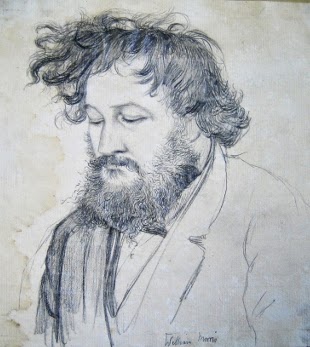
William Morris by C Fairfax Murray 

and for a comprehensive account of ALL portraits of Morris - paintings, drawings, caricatures, busts, photographs - go to Carol Blackett-Ord's scholarly list of All Known Portraits in the LATER VICTORIAN CATALOGUE on NPG website.  Which links through to all those in the NPG collection and many elsewhere:

http://www.npg.org.uk/collections/search/personExtended/mp03189/william-morris?tab=iconography

Wednesday, 16 July 2014

Moroccan Ambassadors


Copyright University of Birmingham 

 copyright English Heritage
The fine portraits of the Moroccan ambassadors 
[1] to Elizabeth I : Abd el-Ouahad ben Messaoud, 1600 by unknown artist, now Shakespeare Centre with legend '1600 / Abdul Guahid / Envoy from the Barbary Kingdoms to England / age 42' 
 and [2] to Charles II : Ben Hadou, 1684, by Godfrey Kneller and Jan Wyck (now Chiswick House)  
have been joined by two splendid images of  Georgian envoys


copyright Ben Elwes
copyright Ben Elwes 

 [3] to George I and George II:   Admiral Hajj Abdelkader Perez, with a naval engagement by Michael Dahl;
and [4] to George I :  Mohammed Ben Ali Abgali by Enoch Seeman.

Both painted during their tours of duty in Britain, and both retained by the courtier who was appointed their host/minder/liaison officer.  
It was obviously a tradition  They make one wonder what the sitters and their  entourages thought of the likenesses in Anglo-mode, half-length or three-quarter-length, and whether any copies were made for them to take home.


Here, incidentally, is John Evelyn's eye-witness account of Amb. Hadou's presentation to the Court of St James:
    

Castle Howard and William Morris


Exhibition alert

<http://www.castlehoward.co.uk/house-and-grounds/exhibitions-2/william-morris.html>


This looks a nice display at Castle Howard, with a great portrait sketch of Morris's unruly hair by George Howard aka Earl of Carlisle, and the three-part Illustrious Women screen embroidered by Bessie Burden.


Tuesday, 1 July 2014

Spitalfields Nippers at Pre-Raphaelite exhibition


The Spitalfieldslife blog by the gentleauthor has publicised a riveting collection of photos taken in 1901-2 by Horace Warner, superintendent of the Bedford Institute, a Quaker mission.   Entitled Spitalfields Nippers, the photos are all of youngsters, in the streets and yards, with one striking group in the newly-opened Whitechapel Art Gallery during the inaugural exhibition of 'Modern Pictures by Living Artists' including the Pre-Raphaelites. This shows five children and a babe-in-arms grouped for the camera in front of several paintings, including two by Burne-Jones - an oil version of the stained glass design of St Luke and a levitating female figure of Hope.    They were presumably loaned by Georgiana, since EBJ died in 1898. One intriguing connection links the photographer with the painter, because Warner's family firm was that of Jeffrey & Co., which printed wallpapers for Morris & Co., in which of course Burne-Jones was an original partner.  Possibly Warner chose to pose his Nippers by Burne-Jones's works because of his connection.

Crowd-sourcing is requested to fund publication of the unique collection.  For more information:
http://spitalfieldslife.com/2014/06/29/an-astonishing-photographic-discovery/ 


UPDATE
and another image of Spitalfields kids (the same group I think) among Pre-Raphaelite pictures


with a link to the published volume here


Wednesday, 18 June 2014

Janey Morris moves to Kelmscott


From 5 July to the end of October, the JANEY MORRIS exhibits from the National Portrait Gallery will be on show at Kelmscott Manor, with minor variations.  This is a most appropriate place, given Jane’s love for the Manor and the newly-printed photos of her, shivering in her shawl on a cold May morning in 1898, that are included in the display.  With luck the next few months will be sunnier.  
Details from the Kelmscott Manor website  and


Also ‘on view’ at Kelmscott, or rather ‘at work’ is the new artist-in-residence, glass designer SASHA WARD, who welcomes visitors to her studio in the Brewhouse.


A couple of shots of the display in the Manor, where the small square white-walled room shows off the drawings and photos very well and very appropriately given Jane's love of the house and garden.  On view until the end of September: 


and to finish with a glimpse of her burial spot in the churchyard, and one of the antique brocade fabric she presented to the church, currently adorning the altar:  


Thursday, 12 June 2014

Help is better than Sympathy


HELP IS BETTER THAN SYMPATHY  is a rather curious slogan, as if the two were opposed.  In most circumstances, Sympathy without Help is not much use, of course, but the slogan presumably means Help as well as Sympathy, please.  And indeed, the phrase comes from a poster designed by Frank Brangwyn for the Belgian & Allies Aid League, at the outbreak of World War One, when refugees from the German invasion of Belgium arrived in Britain. “Will you help these sufferers from the war to start a new home”, it asks. “Help is better than sympathy.”   Brangwyn was born in Belgium, so his sympathies were fully engaged.

The chief trigger for Britain’s war declaration in August 1914 was the violation of Belgian neutrality; otherwise, there seemed no urgent reason for British participation in the imminent conflict.  But once the die was cast, four terrible years of almost innumerable deaths and futile hatred ensued, whose aftermath is still palpable a century on.

Brangwyn’s second career as a poster propagandist is examined in the latest exhibition at the William Morris Gallery  - which he actually founded by bequeathing his collection to the local council in honour of Morris, who grew up there.  As with other WWI commemorations this year, it’s a sobering display, with its monochrome visuals, Brangwyn’s heavy, angry, black graphic style and above all its subject.  The ‘worst’ work, in the last sense, is his 1918 poster for War Bonds [surely extorted from a population who had already overpaid in more than money] urging a Final Push in the form of Tommy bayonetting Fritz face-to-face, with evil ferocity.   It is said that even the War Bonds department thought this mistaken ardour.    But so had Sympathy for Belgium transmuted into Violence towards Germany.

More details of the exhibition here: http://www.wmgallery.org.uk/whats-on/exhibitions-43/help-is-better-than-sympathy/

Tuesday, 10 June 2014

The Lost Peacock


Not news but worth sharing: the four drawings by Philip Webb made for a tapestry woven by Morris & Co in 1887.  As he often declared, Morris's own talent was for pattern-making, borders and overall arrangement - of windows, pages, tapestries.  Burne-Jones typically drew the figures and Philip Webb's specialty was animals and birds, particularly birds.   He drew splendidly vigorous  cocks, ducks, geese, hens, herons for Morris & Co tiles and glass quarries -  some  for example at Red House.    

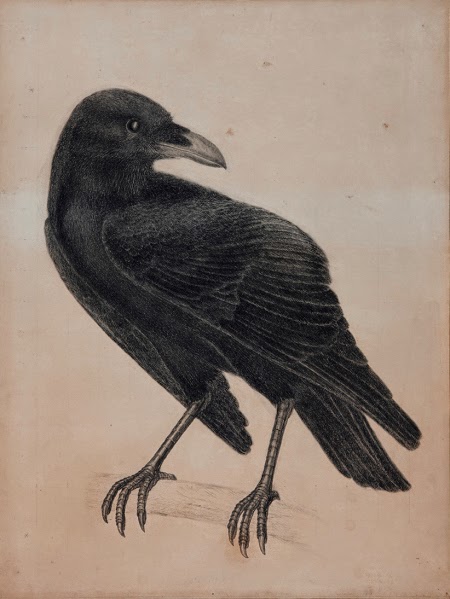
Four drawings - of a hare, a lion, a fox and a raven - by Webb made as animal studies for  a tapestry called  The Forest, produced by Morris & Co in 1887 are now in the National Trust's collection at Wightwick Manor outside Wolverhampton.   Four and a half metres wide, and woven at Merton Abbey by William Knight, John Martin and William Sleath, the tapestry is now in the V&A collection but is currently on display at Wightwick also.
The Forest, tapestry, woven wool and silk on a cotton warp, designed by William Morris, Philip Webb and John Henry Dearle, woven at Merton Abbey by William Knight, John Martin and William Sleath, 1887, 121.9 by 452 cm. ©Victoria and Albert Museum, London, purchased with the assistance of the Art Fund

The watercolours were originally owned by Laurence W. Hodson, a neighbouring Wolverhampton industrialist t who lived at Compton Hall, which like Wightwick was furnished with Morris & Co. textiles and wallpapers.  The most striking of then is the Raven [top] 

But the Forest shows five creatures - including a peacock which sits at the far left edge opposite the raven, and it is assumed that Webb drew a study for this too.  Now drawings of peacocks were fairly common in the 1880s and 1890s  [I've just seen an Italianate scene by Marie Spartali Stillman that includes three of them]   so Webb's lost peacock may be hiding unrecognised somewhere....  Let's hope so.