Sunday, 2 August 2015

Marie Spartali and the Etruscans


As well as revealing Marie Spartali’s serious and successful exhibiting career in the United States, research for the forthcoming Poetry in Beauty exhibition at Delaware Art Museum (see post for 14 March) has discovered her very fine, atmospheric landscape painting.
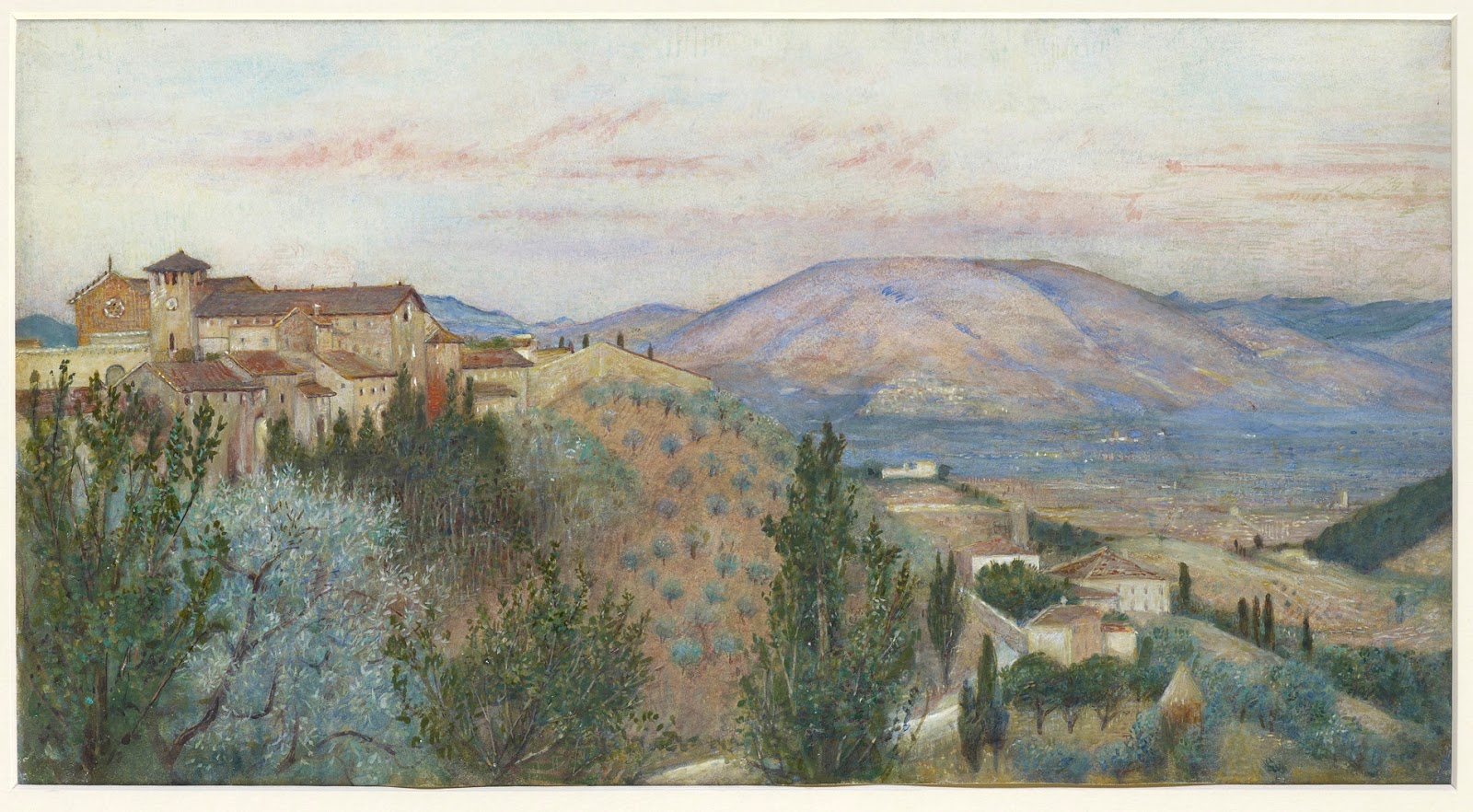
Monte Luce from Perugia; private collection 
Hitherto known chiefly for ‘Pre-Raphaelite’ female figures, embowered in flowers and foliage, this aspect of her art, pursued throughout her life, deserves greater scrutiny.  Her earlier landscapes tended to depict scenes and location on the Isle of Wight where the Spartalis had a summer residence (now the barely-altered Rylestone Manor hotel).  Later, after she moved to Florence and then Rome, Italian landscapes naturally featured.  The 1890s saw a strong and striking development linked to Marie’s acquaintance with the group of artists now known as ‘the Etruscans’, which was headed by Giovanni (Nino) Costa and also attracted several British and American painters, including Frederick Leighton and Edith Murch Corbet.   
These artists, many of whom exhibited with Costa’s  In Arte Libertas shows from 1886 to 1900, remain understudied although not wholly neglected.  Rather than the familiar warm sun of  the South, their art  favoured a cooler light, typically that of early spring and early morning, wide horizontal views and gentle, often unremarkable vistas.
Spartali spent at least one memorable season alongside Costa while staying in Perugia, guest of fellow artist Lemmo Rossi-Scotti.  Costa’s habit, which Marie doubtless copied, was to rise and dawn and paint out of doors till mid-morning, resuming in late afternoon until dusk, partly perhaps to escape the mid-day heat but also in pursuit of evanescent atmospheric effects.  There were day-long excursions too, mixed in with appropriate reading from Italian sources, notably those relating to St Francis of Assisi, just 25 km from Perugia.  
Lago di Nemi; private collection
 Back in Rome, Spartali visited the famous Lake Nemi, once sacred to Diana or Artemis, depicting it in soft, pearlescent tones, and also sketched with Costa by the ancient Ponte Nomentana.   These are among the most delicate and evocative of her landscapes.  Other favoured scenes included light-filled woodland in spring, with slender trees vouchsafing a distant view of hill or hill-top town.   Often, but not always, she added figures to the landscape.  These provide scale and human interest, which was maybe chosen to appeal to buyers, for Spartali was always a professional artist with an eye to exhibition and sales.  Several of the scenes suggest however that her main pictorial interest lay in the skies, and the desire to capture their subtle atmospheric effects at different times of day.
Ponte Nomentana; Morgan Library & Museum NY

Monday, 13 July 2015

Keir Hardie by Sylvia Pankhurst


by Sir Leslie Ward for Vanity Fair, 1906
Another Socialist hero was the Labour leader Keir Hardie, the centenary of whose death this year might prompt reflection on the party’s fortunes.  It was Hardie who led the first substantial contingent of Labour MPs in the early 1900s and who helped change both the image - from top hat to cloth cap - and the content of British politics.

“From now until November the National Portrait Gallery presents a selection of portraits of the first leader of the Labour Party in Parliament, James Keir Hardie (1856-1915), to mark the centenary of his death on 26 September 2015. During his comparatively short fifty-nine years Hardie was a miner, a trade unionist, a journalist, an editor, a Member of Parliament and an anti-war campaigner. A key figure in the creation of the Labour Party as a political force, Hardie helped to radically alter the political landscape of Britain. Unique in his ability to speak directly to and for the industrial working-class in the late Victorian and Edwardian eras, he was committed to ethical socialism, to the political independence of Labour and to women’s suffrage."


The NPG possesses two portraits of Hardie by Sylvia Pankhurst, Socialist, Suffragist and artist. Drawn in the final years of his life, they sadly record a prematurely aged figure, but  Pankhurst’s words testify to the significance of his life’s work.  On his death she described him as 'the greatest human being of our time' and in offering her larger image to the NPG she wrote that his place in history was important. 'I am conscious that this is only a sketch and was purely a preliminary study to assist me to do a painting.  I should not have ventured to offer it to the the National Portrait Gallery save for the fact that I believe you have no other portrait of Keir Hardie.  I think it does give an idea of the kind of man Keir Hardie was'.

On 3 September, Melissa Benn (whose late mother Caroline Benn wrote Hardie's biography) will be in conversation with Keir Starmer MP, in the NPG lecture theatre. 

Sunday, 12 July 2015

WMS @ 60

WMS @ 60

THE PRESENT WILLIAM MORRIS SOCIETY, successor to earlier groups and fellowships, was launched in 1955 to celebrate his life, works and continuing impact on politics, design, conservation, crafts and critical thought.  
For a single, long-dead, bearded Victorian, William Morris’s ideas have enjoyed an astonishing multifarious afterlife, and the diamond ( = enduring) anniversary of the Society is being marked this 5 September with a whole-day symposium William Morris in the 21st Century.  
The focus is on radicalism and future perspectives regarding political action, environmentalism, education, utopian designs and human relations with the natural world. 


Details of when and where are on the attached pdf .  Everyone is welcome to what is hoped will be a stimulating day of discussion and debate.  There are many points of contact between the turmoil of Morris’s time, before the formation of any Labour or Communist parties, and that of today, when new approaches to local and global situations are being formulated.

 This is part of my introduction to the day:
WM's life and ideas remain startlingly in fashion, in quite disparate ways.   Last month the Daily Telegraph listed his bedroom at Kelmscott Manor among its top 50 ‘Hidden Gems’; and in July  Country Life celebrated 60 things it declared ‘the best of Britain’.  Grouse moors, tea at the ritz, hunting horns and the monarchy. Then, flanked by public schools and parish churches, was WM wallpaper, his instruction about what to have in your house and the declaration that the Arts and Crafts movement was ‘part of a wider socialist vision for moral improvement and wholesome living,’ that still inspires today. And so he is beloved even by the reactionary press.
Just weeks earlier, a leader column in the Guardian written by Charlotte Higgins proposed WM’s ‘splendidly bearded visage’  for the new £20 note.   She argued:
‘Morris would be a hearteningly radical choice, despite the chintzy reputation.  Stanley Baldwin might have failed to mention Morris’s politics when he opened the V&A’s centenary exhibition in 1934, but … he was a revolutionary socialist who wrote and lectured tirelessly, who addressed the striking miners of Northumberland in 1887, who marched on Bloody Sunday to Trafalgar Square. He wished to see a world in which there were neither “brain-sick brain workers, nor heart-sick hand workers … in which all men would be living in equality of condition.”  Of course there were contradictions in this revolutionary-cum-luxury-retailer. But these would be elegantly encapsulated by his gracing the currency. In short, Morris was, “one of those men whom history will never overtake”.
 This all might make one suspect that WM is ‘all things to all men’  – somewhere we can each find confirmation of our likes and dislikes, prejudices and preferences.   But I think his legacy is more stimulating and provocative.  One cannot like everything that WM said or produced; indeed, one must often argue with his politics and his patterns. 
 And it is something of a mystery to me why the Society founded to promote the contemporary relevance of his life and work (to quote the recent business plan) has not over six decades split into constituent strands or sects – some to celebrate stained glass, others to debate anarcho-syndicalism; some to study the Sagas, others to build new cities;  some to analyse utopias, others to print beautiful books.   There are these tensions and complexities as there have been ever since Morris’s time, at least, when Bernard Shaw divided the progressive movement between those idealists who wished to sit among the daisies and those who wished to organize the docks.  But the Society has room for all in a spirit of diversity within commonality.
 Above all, WM’s legacy remains powerful  because we do not regard it as primarily  historic.   It belongs to the present and future as well.  Recently I was invited to a symposium, on the theme ‘Would WM have used an i-pad?’    Well, it’s an interesting question with a less simple answer than might at first appear.  

While I think that i-pads will possibly have a fairly short life-span, owing to the speed of change in an electronic, digital and frankly astonishing age, we must also contemplate ‘how we live and how we might live’.   


Sunday, 14 June 2015

Marie Spartali and Julia Margaret Cameron


In the late 1860s Marie Spartali (born 1844) acted as model for pioneering photographer Julia Margaret Cameron (born 1815).  Both families had holiday homes on the Isle of Wight and were acquainted through the Pre-Raphaelite painters.   The photo sessions took place in Cameron’s studio in Freshwater, over several days, Marie recording the fatigue of sitting  for repeated shots. 

Marie was at this time studying with Ford Madox Brown and enjoyed a successful exhibition debut in 1867.  Cameron was always seeking willing models for her photographic compositions where sitters were posed  as fictional and allegorical figures, requiring elaborate preparation and accessories.  Marie posed as ‘Imperial Eleanore’ from Tennyson’s poem, as Hypatia, as 'The Spirit of the Vine', as Mnemosyne Mother of the Muses (maybe in allusion to her Greek heritage),  and as The Duenna.

Some of the original prints, given to Marie by Cameron, will feature in our forthcoming exhibition Poetry in Beauty The Pre-Raphaelite Art of Marie Spartali Stillman, at Delaware Art Museum and the Watts Gallery next winter.  

I will also be showing them at the forthcoming conference marking Cameron’s bicentenary, when I argue that Cameron’s example as a professional female artist, committed to perfecting her then-difficult medium, and to exhibiting and selling her work, served as a role model to Spartali, especially after she herself married and took on domestic responsibilities, when women were conventionally expected to give up professional practice. 

I further explore the links between Spartali, Cameron’s niece Julia Stephen - who composed her aunt's entry for the 1886 Dictionary of National Biography -  and Julia’s daughters Stella, Vanessa and Virginia, suggesting that in turn Marie’s long exhibiting career was an encouragement to a younger generation, struggling against the engrained prejudice (as Woolf put it) that ‘women can’t write, women can’t paint’.  

The conference is organised by University of Portsmouth, 3-5 July 2015. 
details here

-   It includes a performance of Woolf’s comedy Freshwater and a visit to the Cameron home and study centre Dimbola on the Isle of Wight.   

Monday, 8 June 2015

Banking hero?

This from Guardian newspaper 'Comment' piece 24 May 2015.
There's some irony in proposing WM for a banknote, when he hoped for ultimate elimination of the capitalism underpinned by financial institutions, but it's a great choice for popular national hero.  Thanks to the Guardian writer for this rousing endorsement.

The quest has begun to find a face for a new £20 note, to go into circulation within five years. Public nominations are being sought until 19 July.   Bank of England governor Mark Carney has narrowed the field to a (deceased) figure from the visual arts – to include architecture, film-making, craft and design.
There is a rich seam of possibilities. Could Emeric Pressburger and Michael Powell, or even Derek Jarman, represent British film-making? Wren has had his turn and Mackintosh has featured on a Clydesdale Bank issue, but what about Sir John Soane, who remains one of the most influential British architects, rebuilding much of the Bank of England itself around the turn of the 19th century? In design, Lucienne Day or Susie Cooper are intriguing possibilities; though if we’re talking ceramics, the great Josiah Wedgwood would be a contender, accompanied, of course, by a teapot, for what could be more British? (Though perhaps he could wait for a new £5, to be immortalised in jasper-style blue and white.) The painter and acerbic social commentator William Hogarth should also be considered; so too the visionary Blake and the sweeping talent that was JMW Turner. This newspaper would heartily welcome Barbara Hepworth: a major figure in the development of modernism internationally, and indelibly linked with both the Yorkshire and Cornish landscapes.

In the end, however, we would suggest that William Morris's splendidly bearded visage is the one to grace the new £20 note. His talents were almost too varied to comprehend: designer and maker of wallpapers and chintz, of course, but also of stained glass and ceramics, of tapestries and embroideries, of calligraphy and illuminated books. He was a poet, a novelist, a writer of early science fiction. He was a pamphleteer, a journalist, a political activist and proto-feminist. He was a campaigner against the wilful destruction of ancient monuments and an environmentalist; he took a sensual pleasure in the beauty of objects and landscapes. He believed passionately in the dignity of skilled and fulfilling work. Ahead of his time, he is a model to a generation of British artists today, such as Jeremy Deller, whose work is multidisciplinary and socially concerned.

Morris would also be a hearteningly radical choice, despite the chintzy reputation (and an appealing offset to Winston Churchill, who will be on the new £5). Stanley Baldwin might have failed to mention Morris’s politics when he opened the Victoria and Albert’s centenary exhibition in 1934, but the artist’s convictions were central to his psyche. He was a revolutionary socialist who wrote and lectured tirelessly, who addressed the striking miners of Northumberland in 1887, who marched on Bloody Sunday to Trafalgar Square. He wished to see a world in which there were neither “brain-sick brain workers, nor heart-sick hand workers … in which all men would be living in equality of condition.”


Of course there were contradictions in this revolutionary-cum-luxury-retailer. But these would be elegantly encapsulated by his gracing the currency. In short, Morris was, as EP Thompson wrote, “one of those men whom history will never overtake”.

Saturday, 23 May 2015

Blackamoors in Florence

  Article  here on the NYU conference and exhibitions in Florence last weekend prompted by the collection of antique blackamoor figures at the Villa Pietra, NYU's Italian campus.


Here is one of them: 


It was an exciting event, packed with scholarship, literature, music and art and attended by hundreds of delegates.  Full details  http://www.blackportraitures.info/

All the papers were livestreamed and recorded so in theory available to hear,  but the sessions were so numerous that it is best to consult the program first.


The RE-SIGNIFICATIONS exhibits - contemporary artists' responses to historic representations - are on three sites through June and July.   These too were so packed with artworks and people that it was hard to capture any useful views, but these give a glimpse:


================================================================

On the weekend of 28-31 May is a large-scale scholarly gathering
  BLACK PORTRAITURE[S] IMAGINING THE BLACK BODY AND RE-STAGING HISTORIES 
organised by NYU in Florence Italy and including a vast range of papers on  literally hundreds of topics.  Rather too many to cover in a blog, but among the attractions is an exhibition 
RE-SIGNIFICATIONS 
that will be on view all summer at the Museo Bardini, Villa la Pietra and  Fondazione Biagiotti Progetto Arte,
SEE  here    


'Lost' pictures by Marie Spartali


Marie Spartali Stillman's exhibition record stretches from 1867 to 1922 and in that period she exhibited around 150 works whose titles and ante quem dates are known.   Although it's been assumed she was generally 'unsuccessful' in seldom selling her pictures, in fact a large proportion were sold.  There are few records of the purchasers, however, and many of the paintings that are now known passed down through the families of her daughter and  son. Which leaves a good number of documented but now lost works whose location is currently unknown. 

One of these, newly identified as Luisa Strozzi, exhibited in 1884, priced at 80 guineas, has recently surfaced through a bequest in Canada.  Fruit of the artist's residence in Florence, and her knowledge of a tragic historical story, this features a Renaissance half-length woman, with the Palazzo Strozzi in the background.  Sadly, this emerged too late for the forthcoming Delaware Art Museum exhibition, which nevertheless includes a good few works that have rarely been seen since Marie's death.


copyright Delaware Art Museum 
Two more tableaux perdus are known from contemporary photographs.  Both were among Spartali's most-acclaimed works and if re-discovered will instate her fully within the Pre-Raphaelite canon, for both invoke the Italianate world inspired by the poetry of Dante and Boccaccio, showing imagined figures from that fictional world and are painted with all appropriate refinement.    That on the right depicts Fiammetta, Boccacio's inamorata, referring to his 'last sight' of her;  that below a scene from Dante's Vita Nuova, showing the poet, Eros, Beatrice and her companion Giovanna.
copyright Delaware Art Museum

A third  painting, this time known from an illustration, depicts another scene from La Vita Nuova, showing Dante overcome with emotion, trembling and faint, at the sight of Beatrice among a gathering at the house of a newly-wed couple. 

If  any of these - or any other 'missing' pictures - should come to your attention, please let us know.  It has been rewarding to reconstruct Spartali's career and start a serious assessment that takes it beyond 'talented amateur, better known as model'.  But a lot remains to be learnt and found.


More details of the  exhibition here
http://www.delart.org/exhibits/poetry-in-beauty-the-pre-raphaelite-art-of-marie-spartali-stillman/

The catalogue, Poetry in Beauty :  The Pre-Raphaelite Art of Marie Spartali Stillman
2015 [ ISBN 978-0-996-06761-4 ]  is now in production by Marquand Books for Delaware Art Museum