Tuesday, 2 August 2022

Modern PR Visionaries UPDATE

STUDY DAY   #

 ##Modern Pre-Raphaelite Visionaries conference


In a Wood so Green, Frederick Cayley Robinson

Date: 9 September 2022

Location: Art Gallery & Museum

Time: 9:00 - 15:30

The conference is open to all, but will be particularly suitable for academics, museum professionals, students, and those with a prior understanding of the field.

Buy Tickethttps://warwickdc.ticketsolve.com/ticketbooth/shows/1173631030/events?TSLVq=c5e02205-112b-4f6c-b93c-2fe3405377aa&TSLVp=19f95679-919f-47db-a965-c4919c99c292&TSLVts=1659101088&TSLVc=ticketsolve&TSLVe=warwickdc&TSLVrt=Safetynet&TSLVh=a6acc4285ce38cefa05a769e4465b5a2

To celebrate our current exhibition, Modern Pre-Raphaelite Visionaries, British Art 1880-1930, Leamington Spa Art Gallery & Museum is organising a conference to explore the themes and ideas behind the exhibition and to examine the ongoing art historical legacy of this period in British Art.

This exhibition has offered the opportunity to re-examine a number of works by a host of ‘forgotten’ British Artists working at the turn of the twentieth century, whose work was inspired by the Pre-Raphaelite Brotherhood and European Symbolism, and who sought to understand their place in the changing modern world. It has allowed Leamington Spa Art Gallery & Museum’s important collection of work by Frederick Cayley Robinson, Simeon Solomon and William Shackleton to be contextualised by loans from across the country, raising the profile of these artists and their significance in the canon of British Art.

Please join us to discuss the life, work and significance of these artists on 9 September 2022 in person at the Royal Pump Rooms. The conference is open to all, but will be particularly suitable for academics, museum professionals, students, and those with a prior understanding of the field.

We are delighted to announce that Dr Elizabeth Prettejohn (University of York) and Dr Sarah Victoria Turner (Deputy Director at the Paul Mellon Centre for Studies in British Art/ Yale University) will be giving the two keynote presentations at the conference. They will be joined by Dr Alice Eden (Research Curator, Modern Pre-Raphaelite Visionaries Exhibition) who will be discussing her work on the exhibition. The full programme of talks and speakers will be announced in due course.

Lunch, tea and coffee will be provided

Proposed Schedule (subject to amendment):

9:00-10:00      Registration, tea and coffee

The exhibition will be open for viewing to conference delegates before public opening hours

10:00- 10:15    Welcome

10:15-11:15    Dr Elizabeth Prettejohn - Revaluations: Stories of British Art 1880-1930

11:15-12:15    New Voices: Presentations by two Early Career Researchers      

12:15–13:00    Lunch

13:00-13:30    Dr Alice Eden - Curator’s Introduction to Modern Pre-Raphaelite Visionaries

13:30-14:00    Break with chance to view exhibition

14:00-15:00    Dr Sarah Victoria Turner - “Cayley Robinson: a mystical modern”

15:00-15:30    Wrap Discussion

 Cost: £15 standard / £5 concessions including students

This conference has been generously supported by the Paul Mellon Centre for Studies in British Art. Modern Pre-Raphaelite Visionaries: British Art 1880-1930 has been supported by the Art Fund, the Garfield Weston Foundation, The Paul Mellon Centre for Studies in British Art, the Albert Dawson Trust and Friends of Leamington Spa Art Gallery & Museum


Wednesday, 20 July 2022

Modern Pre-Raphaelite Visionaries


Simeon Solomon, The Sleepers and one that Watcheth, 1871

RATHER a mouthful for the temporary exhibition at Leamington Spa art gallery [moving on to Watts Gallery in some form],  chiefly because there’s no commonly used term for this brand of late Romantic painting in British Art 1880-1930 – the show’s more comprehensible sub-title.


The actual date range is even wider. Some exhibits are well-known: Rossetti’s 1864 Roman de la Rose; Simeon Solomon’s 1870 Sleepers and one that Waketh; Dicksee’s 1877 Harmony;   Thomas Gotch’s 1896 Alleluia; Evelyn de Morgan’s undated Queen Eleanor and Fair Rosamund.   

Most however are unknown or new to public view and assessment.  Frederick Cayley Robinson, who is the chief focus, is hardly known even to historians.  Together the exhibition and its catalogue – both the work of Alice Eden – aim to position him in the interstitial space between 19th and 20th century fantasy.    The focus is on mystery and enigma, which frequently arises from Robinson’s titles.   The Foundling, for instance, is a fairly standard bedtime scene, where the child has fallen asleep by firelight and her mother lifts the coverlet prior to helping her into bed.  But why ‘foundling’?  the term sets the viewer hunting for cryptic clues to the girl’s origin. Is the bandage on her bare foot meaningful?

The Close of the Day is not dissimilar, especially in view of its candlelit illumination, with three young women around a dim table with an open musical box, a folio volume of  something like an illustrated periodical and a devotional painting hard up against a darkening window.  The commentary quotes a contemporary account of Robinson’s atmospheres – ‘something is portending’ but we don’t know what.

Puvis de Chavannes, Odilin Redon, Fernand  Knopff and the Glasgow ‘Spook School’ all portend: twilights, liminal spaces, dreamscapes, inaudible melodies feature in these artworks, by artists trained in accurate drawing of observable objects and figures.

A major inclusion are Robinson’s five crepuscular designs for Maeterlinck’s Blue Bird, which in its pre-1914 day eclipsed Peter Pan as a theatrical ‘must-see’.  The Forest is especially resonant.  

It links also to the Leamington cover-choice, Robinson’s In a Wood So Green, where an aureoled St George rides through a forest of slim birches oblivious of the sorrowing Princess whom he should surely be saving. A good few stories can be inspired by this impenetrable piece.


I haven't yet seen the installation, so I am going mainly on the catalogue, with its significant contributions from Colin Cruise, Liz Prettejohn, Tim Barringer, Sarah Victoria Turner and Charlotte Gere, so deserves to be taken seriously in its scholarly approach to neglected fields.  It’s now over a century since Robinson and coevals were considered worthy, so they merit an overdue revival and revaluation – indeed, a first evaluation, having been ignored for so long.


Saturday, 18 June 2022

The Barrett Plantations


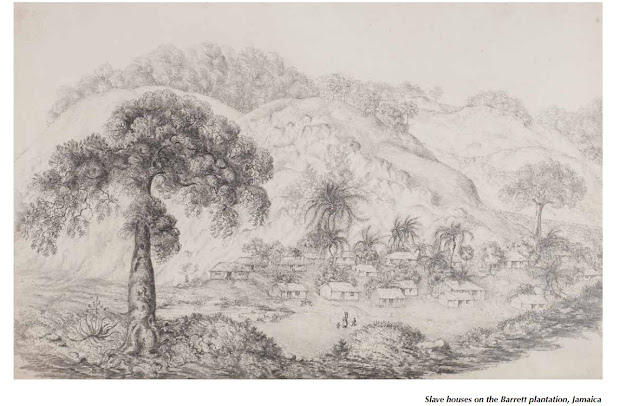
Some pencil sketches of the Moulton Barrett estate at Cinnamon Hill on Jamaica are for sale at Karen Taylor Fine Art.  They were drawn by Mary Clementina,  young wife of the Barrett son sent to manage the canefields in 1830 (who did not long survive her Caribbean transplantation)

Those illustrated include this distant [from the big house] view of the enslaved workers' homes

 Mary Clementina Barrett [1803-1831]     Slave [sic] houses on the Barrett Plantation

 together with an essay defending the Barrett slaveowners as devoted to the welfare of their workers - of which is adduced the proof that Cinnamon Hill was not torched during the revolt of 1831, which pushed forward the emancipation.   This account summarises information from an Abolitionist visit in 1837:

Two Quakers, Joseph Sturge and Thomas Harvey, went to the West Indies to inspect the condition of the newly emancipated Black population. Visiting Jamaica in February 1837, they were invited to visit Samuel Barrett’s estates. They wrote of the Retreat estate that: 
‘[it was] an estate of great extent beauty, being several miles in length and depth, and comprising both pasture and mountain woodland—It is managed by a black overseer named Samuels, who was born a slave on one of the estates of his present Master. He is now free, and though he can neither read nor write, the property under his charge is in the finest order, and the people in the best discipline. With perhaps the single exception of the apprentices on Hopeton and Lenox estates, the Retreat negroes possess, we believe, greater advantages than those on any property in the island. 
'We walked with the overseer through the negro village. The houses are comfortable, and many of them of considerable size, and situation in the midst of neat gardens. They had shingled roofs and cement or boarded floors. Most of the people were at their provision grounds, but Samuels introduced us to such as we found in the houses….they all appeared to be in prosperous condition’ .
'The whip had been abolished ever since the proprietor came to reside in the country’ and after abolition ‘the free children thrive ‘because Mr Barrett takes notice of them’ i.e. gives them the same allowances of clothing and causes the same attention to be paid to them as during slavery’ ‘[W]e afterwards saw the estate school…the classes read and spell correctly, and a few of them wrote to dictation. The school does great credit to the teacher…
'We were afterwards shown over the hospital, which is a good and airy building. We met there the medical attendant, who is a coloured man and an irregular practitioner, in considerable practice. He was formerly a slave on this property, but purchased himself because his wife was free.’ .
Sturge and Harvey continued the narrative of the humane slave owner moved to improving the condition of their slaves upon first-hand experience of their plight. This humanitarian self-presentation was shown in the parish chronicle upon the death of Mary Clementina death in 1831 when, it recorded, she was ‘beloved and bewailed not by her intimate friends only, but by all her negroes’.

Her widower, who was uncle to Elizabeth Barrett Browning, died in 1837.  Under the Compensation Act, the family received over  £12,000 compensation for the 'loss' of their enslaved workforce.


Thursday, 2 June 2022

Marie Spartali Rediscovery part one


Marie Spartali Stillman, The Last Sight of Fiammetta, 1876


it's always great when a work not seen in public for decades re-appears,  but a special welcome to Spartali's stunning Fiammetta - a real gem and of significance both for her own now rising reputation and for its relation to Rossetti's later Fiammetta..

 As Pamela Gerrish Nunn and I observed many years ago, when the present work was known only from its listing in the Royal Academy catalogue for summer 1876:

‘Eighteen months later, Rossetti asked Spartali to sit to him for his own version of Fiammetta.  Since her reputation as a model has tended to obscure her career as an artist and since she is typically said to owe her pictorial inspiration entirely to Rossetti, it is worth noting that in this case her choice of subject evidently stimulated his own, and that by ‘casting’ Marie as Fiammetta, so to speak, Rossetti implicitly recognised her choice of the theme’. [  Jan Marsh & Pamela Gerrish Nunn, Women Artists and the Pre-Raphaelite Movement, 1989, p103]

As Pamela now remarks,  'what a beauty!  Surely destined to be seen as her masterpiece[sic]'.

Inspired  by and titled from an early Italian  sonnet  that Rossetti translated and was re-published in 1874, the subject is the supposed inamorata of Boccaccio  a more or less fictive figure like Dante's Beatrice and Petrarch's Laura.   She is depicted here as a  girl - say in her early teens - dreamily fingering a mandoline amid a bower of roses. 

The format is one popularised in the 1870s wave of Pre-Raphaelitism, which appealed to patrons in the manner of Venetian courtesans or Kneller's Hampton Court Beauties.  This is a large work, in watercolour, where  the figure is finely painted, especially  in the delicately conveyed flesh tones, and the surrounding foliage is more loosely rendered, in order to focus the viewer's attention on Fiammetta.

The picture will be auctioned in September at Bonhams in Bond St - so this is by way of a preview.


Monday, 16 May 2022

Fanny Cornforth as Woman in White


 from  Foreword to Stunner: the Fall and Rise of Fanny Cornforth new edition by Kirsty Stonell Walker 

Active, interesting ‘afterlives’ have been created for several of the young women who acted as models in Pre-Raphaelite paintings.  ‘Acted’ is the right word, for a model plays a role, often in costume, in much the same way as a stage performer.  The role may sometimes overlap with real life, but as showbiz interviews disclose, the actual person should not be identified with the parts she plays.

Fanny Cornforth was the ‘stage name’ of young Sarah Cox, who modelled for Pre-Raphaelite paintings of fallen women and alluring beauties,  and whose character was maligned by commentators who described her as a vulgar, thieving whore.  Kirsty Stonell Walker rose to Fanny’s defence a decade ago, using documentary sources and her own instinct to produce a vigorous and engaging biography.  

She was an undoubted ‘stunner’, physically attractive with a fine figure, sweet features and ‘a mass of the most lovely blonde hair – light golden or harvest yellow’.   Kirsty made Fanny the star of her own story, not just a supporting figure in the Pre-Raphaelite soap opera, as the bosomy, grasping ‘mistress’ of Dante Gabriel Rossetti.   Now, thanks to the reach of the internet coupled with wider and deeper historical research,  much more information is revealed.  This revised edition includes new facts about Fanny’s girlhood in Sussex, about her second marriage and life after Rossetti, and a full account of her last years and death from dementia. 

To this is added an enjoyable critical account of Fanny’s subsequent ‘appearances’ in fiction and film – where of course historical characters play new roles.   Fanny Cornforth has a future as well as a past.


NOTE  on  Saturday 22 May at the Royal Academy weekend course on Jo Hiffernan as Whistler's model and muse, I  will summarise Cornforth's comparable role as Rossetti's 'Woman in White'

https://www.royalacademy.org.uk/event/reframing-the-muse 


Wednesday, 4 May 2022

Young Teacher's new home UPDATE


The painting has now been subjected to an export deferral by the Secretary of State to allow time for a UK gallery or institution to acquire the painting.   Here's hoping!


Rebecca Solomon, The Young Teacher

Good news that the Rebecca Solomon genre painting featuring Fanny Eaton as an Indian ayah with two white youngsters has been purchased by Princeton University Art Museum.

Photo shows the unframed canvas in NPG conservation studio prior to Pre-Raphaelite Sisters exhibition in 2019.   

it will join another image of Eaton in the Princeton collection, head study by otherwise unknown Walter Stocks.


Thursday, 28 April 2022

the Morrises at home


Suzanne Fagence Cooper previously chronicled the adept manner in which Effie Gray extricated herself from an unhappy, unconsummated marriage to John Ruskin in order to become the wife and artistic partner of John Millais.  In ‘How We Might Liveat Home with Jane and William Morris’ she traces the Morrises’ shared and separate lives with clarity and judicious assessment.  

The marriage of William Morris, designer-businessman, and Jane Burden, stableman’s uneducated daughter, has always been the subject of curiosity.  Not so much for its cross-class features, which were relatively common in the Victorian age, but for its sequel.   Eight years after the wedding and the birth of two children, Jane began a love affair with artist Dante Gabriel Rossetti, Morris’s friend and business partner – with the agreement if not approval of her husband.

William Morris is everyone’s hero.  Jane has a terrible reputation, as silent, sulky, faithless wife.  With sympathetic warmth, Cooper leads us through the couple’s experiences.  She imagines them in various locations but does not invent their thoughts. Some known details are omitted – Jane’s unfulfilled wish for a son, her clandestine correspondence with Rossetti, Morris’s extravagant spending.  But there is so much to include.  Notably the evolution of Morris’ aesthetic taste from quaint medieval to proto-modern plainness, plus the analytical account of the tiny ornamented booklets that Jane created - when and for whom were they designed?  

No letters from Jane to Morris or his family survive, so we don’t know what she called him at home.  In the group, he was ‘Topsy’ or ‘Top’; outside it would always be ‘Mr Morris’.

In its focus on personal lives, biography like this is not ‘history from below’ so much as what Phyllis Rose called ‘higher gossip’.   It draws readers along engaging narratives to which we can relate.  Morris, whose achievements are so various in poetry, design, manufacturing, politics, calligraphy, translation and publishing, also wrote of his ‘disappointments and tacenda’ – about which to keep silent.  These include his failure as a lover, and most painfully, the awfulness of Jenny’s epilepsy, which struck when she was fifteen, blighting both her own days and those of the family.   Jane grieved acutely and had her own ‘unspoken’ list of regrets.

The strength of Cooper’s storytelling, signalled in the book’s subtitle, is its attention to how wife and husband created each of their homes, with comfort and fine objects but no luxurious superfluity.  If we can believe it, nothing that was not either beautiful or useful.  

Their relationship, too, was a shared construction, mortared with tact, which weathered the storms.  When Rossetti’s guilt for  ‘stealing’ his friend’s wife drove him to a paranoid breakdown, Morris allowed him to convalesce at Kelmscott until Jane acknowledged the affair was at its end.    Morris did not  gloat over this outcome, and the subsequent affection  between the couple was noted by all observers.   Jane devoted her widowhood to securing Morris’s memory through books and buildings – his lifelong pleasures.