
Monday, 25 October 2021

Monday, 20 September 2021
Lucy and Cathy

Two significant artists were missing from my recent Pre-Raphaelite Sisters exhibition at the National Portrait Gallery. Omitted owing to an already over-crowded cast-list, their absence was especially regretted as these two were literal not metaphorical sisters.
Half-sisters, to be precise. Lucy and Catherine were daughters of Ford Madox Brown, the doyen or daddy of the PRB, who declined to join the band because of its juvenile title, but who provided close support to the Pre-Raphaelite aims.


Both produced modest but accomplished and original works, which are virtually unknown as they remain in private hands. Descendants have been proud to retain the sisters’ pictures, according to exhibition curator Ruth Brimacombe. So the new exhibition offers a rare opportunity to view hitherto unseen works by the ‘lost Pre-Raphaelites’ Lucy Madox Brown and Catherine Madox Brown.

Lucy’s early work The Duet, (RA 1870) presents an unexpected 18th century scene with elements of chinoiserie, but her preferred subjects were drawn from drama and history – notably Romeo at the Tomb, Ferdinand and Miranda playing chess from Shakespeare and The Magic Mirror, from a legend about the Earl of Surrey by Thomas Nashe [at top]. All were marked by distinctive imagination and, especially, fine colour effects, they extend the Pre-Raphaelite canon in respect of both style and content. The Magic Mirror (aka Fair Geraldine) is especially welcome – theme and handling wholly within the PR mode, yet the subject quite original.

Cathy’s companion portraits of her parents deserve wider circulation, although only that of her father is included in the exhibition. She perhaps had more natural artistic talent, endowing portraits and contemporary genre scenes with visual interest and harmonies, yet more conventional subject choices. The child puzzling over the sum 9+6 on her slate in A Deep Problem (1875, BMAG) combines charm, observation and empathy. At The Opera (1869) is a stunning take on the usually formulaic half-length female with decorative accessories. Was Marie Spartali the model?

Friday, 27 August 2021
Evelyn de Morgan alert
A warning to scholars writing or thinking about Evelyn de Morgan's artworks:
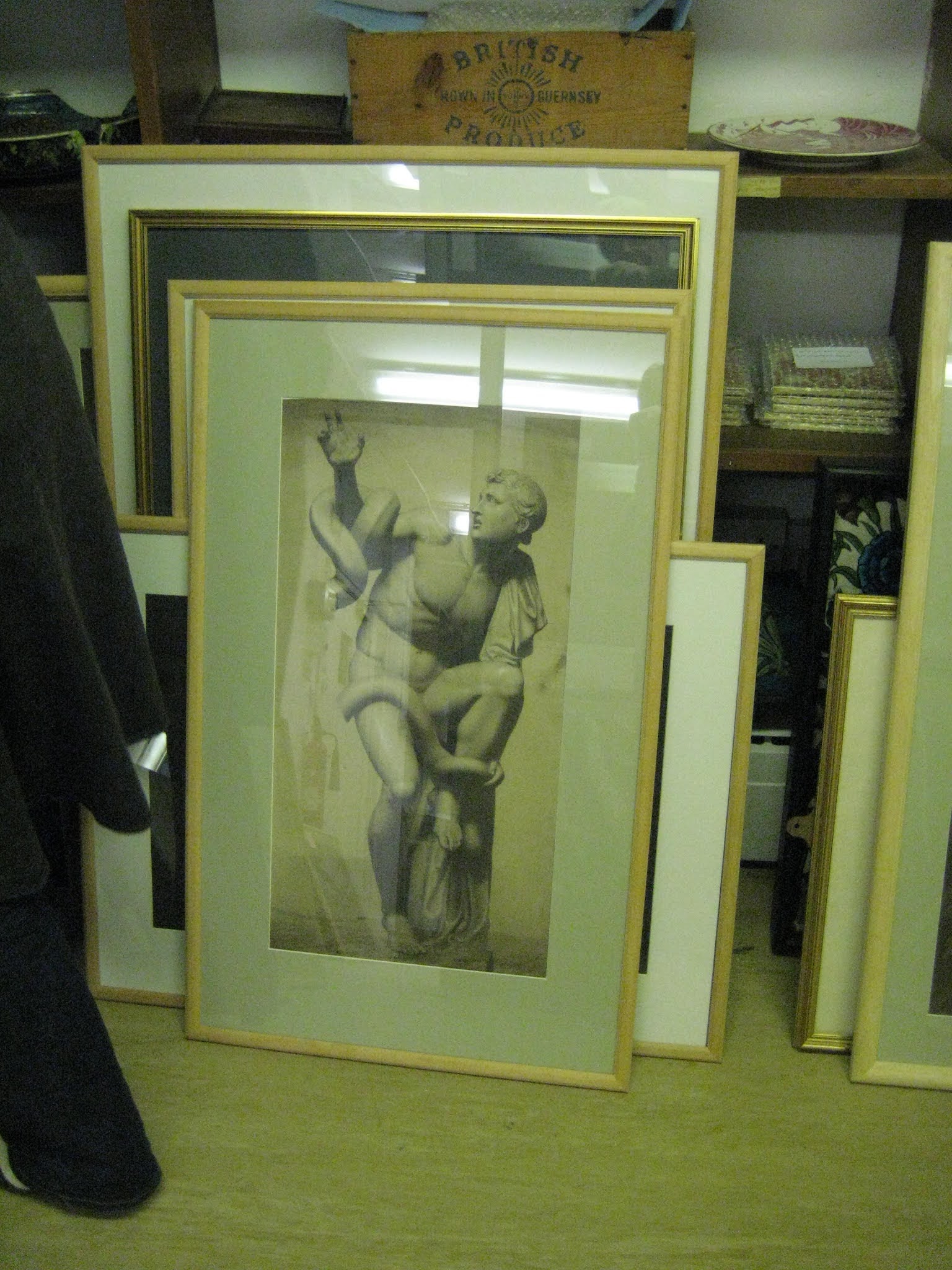
Like his wife, William trained as a painter, but fairly soon changed to the decorative arts, designing and firing the ceramic ware for which he is famed.
The first mis-attributed work is a student-style study drawing of part of the famous antique sculpture known as the Laocoon, showing Laoccoon and his sons wrestling with a giant python. Every art academy in Europe probably had a cast of this, and it was a typical challenge to students. If she did not draw this study, Evelyn no doubt knew the piece well. Its graphic style is similar to her careful depiction of e.g. the Discobolous cast, so the DMF error is only surprising if it has documentary info on the drawing which ought to have prevented the mistake.

The second work is the painting of Mercury, messenger of the gods, with winged ankles and helmet, holding s snake-entwined caduceus. This is more problematic as it certainly resembles Evelyn's work more than William's, and neither its date nor full provenance are securely known. It was apparently acquired in 1910 by Wilhelmina Stirling, Evelyn's sister, when both William and Evelyn were alive, and will have known the correct authorship.
Such emendations to published information are an art historical hazard.
Monday, 23 August 2021
Maria Zambaco Sculptor


It’s now clear there are several casts of L’Amour irresistible around the art market, indicating that it proved a relatively popular piece. Also that it dates from 1896, when it was on show at the Beaux Arts in Paris.
in fact it’s possible to expand Zambaco’s known oeuvre quite substantially, thanks to now-easily-searchable sources and with the knowledge that from the late 1880s she also used her birth name, exhibiting as M.T.Cassavetti.
Among the first exhibits at the 1886 RA (as M T Zambaco) she showed a terracotta bust of Alphonse Legros, the professor under whom she studied at the Slade School, and who perhaps encouraged the submission to the RA summer show, together with another work ‘Study of a Head’ that may have been a second bust, or a bas relief, as the medium is not specified. A new bust, listed as ‘Portrait of a Lady’ was at the RA in 1887, the same year as portrait medallion depicting Lily Langtry was executed - wrongly naming her 'Lydia'.

Then in 1888 came a bronze bust ‘Medusa’s Horror’, presumably with snake-filled hair and terror-filled expression.
In 1889, as M.T.Cassavetti, she submitted two decorative works to the second Arts & Crafts Exhibition Society show at the New Gallery in Regent Street. One was a plaster ‘study for a house decoration’ and the other a ‘Tangerine fireplace’ cast by Enrico Cantoni, a London-based plaster moulder.
By this date, she had partly relocated to Paris, to study under Auguste Rodin, sculpture doyen, and in 1889 exhibited at the Exposition Universelle a patinated figure entitled ‘Tentation’, which was accompanied by a case of portrait medals – possibly the same group that she asked Rodin to get forwarded to the Salon in 1890. ‘Tentation’ sounds so tantalisingly comparable to L’Amour irresistible that it’s a pity neither it nor most of the other works are located.

However, her portrait medal of Auguste Rodin Sculpteur, dated 1888, is to be found in the Musee Rodin, complete with a reversed ‘N’ in his name, which seems a surprising beginner’s error for an artist who was by now well-practised in medal-making.
So Zambaco's output is shaping up to be more substantial than we thought.
Wednesday, 21 July 2021
Clare Mackail
 |
| Georgiana Burne-Jones and Clare Mackail, NPG |
The Burne-Jones universe knows about the BJs’ children
Philip and Margaret. And Margaret’s elder children, Angela [Thirkell] and Denis
Mackail.
But there was a
third grand-daughter – Clare Mackail – who isn’t much mentioned in the biographies. Just a passing reference by Fiona MacCarthy,
not surprising since her subject, EBJ, died just a couple of years after Clare’s
birth, but raising a slight curiosity, since descendants of famous people often
feature in their life stories, fleetingly or a source of family anecdotes.
I worked out that Clare is the solemn grand-daughter pictured with GBJ in photographs by Emery Walker taken around 1900 and passed to the NPG in 1960 with a whole lot of glass negatives from the Emery Walker archive.
And she was given GBJ’s pen and ink illustration to Thomas Hood’s Bridge of Sighs, according to GBJ’s inscription on the back.
Born in
June 1896, the youngest Mackail started at St Pauls’ School for girls at age
12. When she left in 1913 her physical
and mental health were causing concern. Through
music and art, her friends included the family of Gustav Holst, plus their
friends Ralph Vaughan Williams and Myra Hess, and fellow students at the Slade
school ‘Pegs’ Ritchie and Reine Ormond, niece of John Singer Sargent. After war was declared in summer 1914, Clare volunteered as a VAD or Red Cross nurse,
serving first in Balham and then at Moray Lodge in Kensington.
At some unrecorded date, she was ‘attacked’, or possibly sexually assaulted, by her brother-in-law James MacInnes, composer, baritone and violent alcoholic, who married Angela in 1913 and was divorced by her in 1917. Clare’s comic sketch of ‘Aunt Clare’ with nephews Graham and Colin on the 49 bus, taking them out to tea and rebuking their table manners, is reproduced by McGee.
In 1918 Clare received 'electric treatment' for an unidentified condition. In 1921 she returned to the Slade for one term in the Life class. After this, there are few sources of information until 1932 when she underwent thyroid surgery. 'I am exceedingly dull by nature', she told artist Will Rothenstein in 1933, 'and of course for years now, having been completely out of touch with the world through illness, have lived entirely in my imagination.'
By 1934 she was living in Hampstead as an invalid lodging with
Louise Orr and her daughter. Soon, she joined
friends in the UK branch of a shadowy theosophical network founded by Eugene
Milne Cosgrove known as The Group. Osteopath and astrological healer Bertha Orton
led the British offshoot as its ‘archbishop’; Louise Orr, Hilda Field and Hilda
Roberts were among the disciples who gathered monthly, to meditate and allegedly worship the full moon.
The meetings, with a deal of occult performativity and
costumes to match, took place at Orton’s homes: Four Winds, outside Farnham,
and 43 York Terrace, Regents Park. They adopted Sufi-style names, Clare becoming
Roshan or Shining Light. Members made several transatlantic trips, evidently
to visit Cosgrove in Illinois and California.
Angela Thirkell would later characterise the group as Clare’s ‘peculiar
female friends and their dotty religion.’ Men were members too, one being an established
astrologer from Harrogate.
When World War Two struck, the circle named itself the Group
for Sacrifice and Service. On the night
of 11 May 1941, ninety-nine members held a 12 hour vigil at York Terrace to
pray for peace. It proved to be the
last night of the Blitz, and at 1.45am an explosive bomb destroyed a neighbouring
building, killing 15 members of the Group, including Orton, Louise Orr and Catherine
Field. Clare Mackail was rescued from
the debris with a broken arm and vertebrae.
She and Hilda Roberts retired to Four Winds, which later passed to a
Sufi group as an inclusive retreat. By the
mid-1960s Clare was living in a small flat in Petersfield, where she died in
January 1975, aged 79.
 |
| Georgiana Burne-Jones and Clare Mackail, NPG |
Friday, 25 June 2021
Beatrice Offer
Beatrice Offer (1864-1920) was an early student at the Slade School, whose artworks display the Slade's hallmarks of confident figure drawing and broad, expressive painting.
A rediscovered selection of her works is currently on show at Bruce Castle Museum, Tottenham, close to where Offer lived with her second husband, businessman and local councillor. They were found in storage by curator Deborah Hedgecock and prepared for exhibition in 2020, now open until the end of 2021.
 |
| Beatrice Offer Love Potion [detail] Bruce Castle Museum |

The most striking are single female figures with a compelling gaze and darkly suggestive settings, often seen by candle- or fire-light. In one untitled piece, a witch with pointy hat and broomstick is glimpsed behind a seated girl. In A Melody a shadowy head appears behind a harpist, recalling Julia Cameron's Whisper of the Muse. In A Love Potion, fumes rise from the goblet of a sorceress, who reclines on a leopard skin [a stock studio prop] with a live bloodhound at her feet, in an unusual horizontal composition.

The Crystal Gazer shows the eponymous subject with a future-telling globe. She wears a green garland and offers the viewer a direct, inviting expression. So far, so 1890s, with a good dose of pictorial occultism, suitable for the era of W B Yeats. The works are accomplished and bold, commanding attention across the room, several with a Rossettian air - trademarks being wide eyes, parted lips, tumbling hair. The brushwork is fluid and stylishly loose especially on the drapery.
 |
| Beatrice Offer |
| Esme Dancing, Bruce Castle collection |
as is seen in Esme Dancing [Esme's real life identity unknown] which is SO Edwardian and surely referencing Isadora Duncan. There's a portrait of novelist Ouida, presumably drawn from photos, and a very interesting image of Hedda Gabler .
 |
| Beatrice Offer, Auntie's Best Bonnet, Bruce Castle coll. |
Not well reproduced in my snapshot, and not obviously Ibsen's rebellious heroine from its title 'Auntie's Best Bonnet'. Deborah successfully linked image and title through this quote, which is Hedda's contemptuous judgement on the new hat belonging to her husband's aunt Julia, which Hedda deliberately mis-calls an old bonnet owned by the housekeeper. In Offer's painting, Hedda holds the album of photographs over which she revives her relationship with Eilert Lovborg, recalling times spent by 'we two on the corner sofa'.
First produced in London in 1891, the play was regularly revived between 1903 and 1911, notably with Mrs Patrick Campbell in the title role.
Offer's personal life was tragic: two sons died in babyhood and her first husband, a sculptor, died soon afterwards in a lunatic asylum. To support herself Beatrice successfully turned to drawing decorative 'fancy heads' for commercial reproduction in glossy magazines, and then, perhaps for consolation, to devotional paintings. A breakdown at age 55 preceded a suicidal leap from her bedroom window. More biographical details from #(94) (DOC) Beatrice Offor Artist 1864-1920 | Alan Walker - Academia.edu

Tuesday, 22 June 2021
Emily Sargent
 |
| Emily Sargent view in Capri, n.d. Pitman Gift, Ashmolean Museum |
Sister to the more famous John Singer - how often is this sort of comment used in respect of women's art? A small exhibition containing watercolours by Emily Sargent (1857-1936) is on display at the Broadway Museum, before transferring to the Ashmolean. This nicely-chosen street view in Capri is one included, demonstrating the artist's accomplishment.
There's some degree of cant about the familiar lament regarding 'neglected' or 'forgotten' women artists, as if posterity were to blame. But some [not all] did not seek attention, much less 'fame' or recognition. They drew and painted for the satisfaction of so doing. If they exhibited, it was often in connection with some charitable endeavour, much like the embroideries and babies' knitwear contributed by others. Emily Sargent was surely one such artist.
At the same time, she did not neglect or forget her artworks. It appears that some hundreds survive. This group belonged to a member of her family, as did 37 others recently presented to Tate Britain [not yet online].
Subscribe to:
Posts (Atom)