Friday, 19 August 2022

who is the boy? [2]

William Dobson, John Byron, 1640s, Manchester U

 A better known but still unnamed Black attendant is seen in William Dobson's portrait of Sir John Dobson [later first Lord Byron] (1599-1652).   The young man, depicted unrealistically as a child in order to convey his social inferiority,, holds the bridle of Dobson's giant grey while Byron points to two mounted figures in the background, presumably referencing Byron's participation in Civil War battles.  He became the first baron Byron following the battle of Newbury in 1643.  The portrait may mark this event, as Dobson was an equally loyal Royalist.  

It would be great to find that the Byrons of Newstead had an African-born groom at this date.  But as both opportunities and resources for portraiture were limited during during the War, it may also be that the African lad is a fictive figure, as it were, included to emphasise the status of this staunch supporter of Charles I.   He must however have been drawn and painted from a living model.  Or was the figure copied from a pictorial source?  

As is doubtless the case.  The horse was taken, albeit perfunctorily, from Vandyck's great equestrian portrait of Charles I, to enhance the swaggering demeanour of Byron, who was famously proud of the scar on his cheek.  The attendant can probably be found in another aggrandising portrait of the era.

Kehinde Wiley used this painting as the basis for his own image of 1st Lord Byron, where a muscly Black model replaces the baron, and the attendant has been ignored. 

Kehinde Wiley, 1st Lord Byron, 2013, MFA Boston


Thursday, 18 August 2022

who is the boy ? [1]

#

There are so many black attendants in 17th and 18th European portraiture that it's hard to estimate their number.   Virtually none are named, and one suspects that many were ciphers and signifiers rather than actual servants. Perhaps the art worlds had a stable of young Africans for use as required.  There were enough such working in wealthy households to supply the demand.

Despite the ubiquity, it is worth noting their presence.   As in the unattributed  portrait  of Sir John Chardin in the NPG [above] and Ashmolean [below].  The picture is so disregarded - because so commonplace - that when reproduced the Black boy holding up the maps is hard to discern.    He is more visible in the monochrome image, which also shows the stupendously ornate frame to this painting.


 The three-quarter 50-inch square portrait dates to about 1710  when French-born Chardin was in his 60s.   Born in Paris, he was a jeweller and diamond merchant who settled in England, becoming famous for his travels to Persia and India, to seek gems and expand trade with the East.  The maps in the portrait  refer to these territories, so the servant is not signalling Caribbean properties, though quite possibly Chardin invested there.  

 In any event, he and the [as yet anonymous] artist chose to represent him with the fashionable accessory of the age, an enslaved attendant.

Wednesday, 17 August 2022

Great Exhibition 1851

 The famous Great Exhibition in London's Hyde Park in summer 1851 included contributions from around the globe in various sections showcasing  industrial and agricultural produce,  including those that would later develop into 'national pavilions'.

Many souvenir publications and images were created to register the Exhibition, including a series of coloured lithographs published Dickinson Bros, illustrating each section with its exhibits. 

 Artist Joseph Nash  (1809-1878) was commissioned to produce pictorial records of the exhibition, and he enlivened the static displays by populating them with appropriately dressed figures, giving the impression of a global audience, albeit sparsely scattered instead of the crowded throng that flocked to the Crystal Palace.

Thus the textiles, equestrian trappings, and  leather goods from 'Tunis' have human accessories wearing fezes.  

Sugar cane and  sacks of unidentified raw material from Trinidad and Bahamas are accompanied by a nursemaid in typical Caribbean attire, in charge of white British children.


while India, grandest of all colonial possessions, with stuffed and caparisoned elephant, is shown with a visiting Moghul group of two men and a boy, escorted by a white gent in top hat.


all and more reproduced in  Dickinsons' comprehensive pictures of the Great Exhibition of 1851: from the originals painted for H.R.H. Prince Albert (Dickinson, Brothers, 1854).

Tuesday, 16 August 2022

Fanny Eaton Memorial

Mary & Brian Eaton in Margravine Cemetery.
The white cross marks Fanny's burial spot.

 When Fanny Eaton died,  she was buried in Margravine cemetery  which stretches alongside the rail line between Barons Court underground station and the new Charing Cross hospital.    Her family could not afford a gravestone, but now her descendant Brian has arranged for a memorial,  which will be installed on 23 September.  Photo to follow.


South Sea Bubble illustrated


Alas, not by a contemporary.  A visual re-enactment rather like a dramatised documentary episode.  By Victorian stalwart Edward Matthew Ward.  One half of a prominent artistic partnership. 

EM specialized in multi-figure costume dramas set in the Georgian era.  Such as the Scene in Change Alley at the moment the South Sea Bubble burst.   Set in 1820, painted and exhibited in 1847.  Now in Tate Collection.


Also in Tate Collection is Ward's imagined image of Dr Johnson waiting vainly for admission to Lord Chesterfield's presence. 


The two pictures include Africans attendant on fashionable ladies.  They advertise Ward's historical knowledge.  And perhaps in the South Sea Bubble painting, a reference to the South Sea Company's trading business in enslaved Africans.

Thursday, 4 August 2022

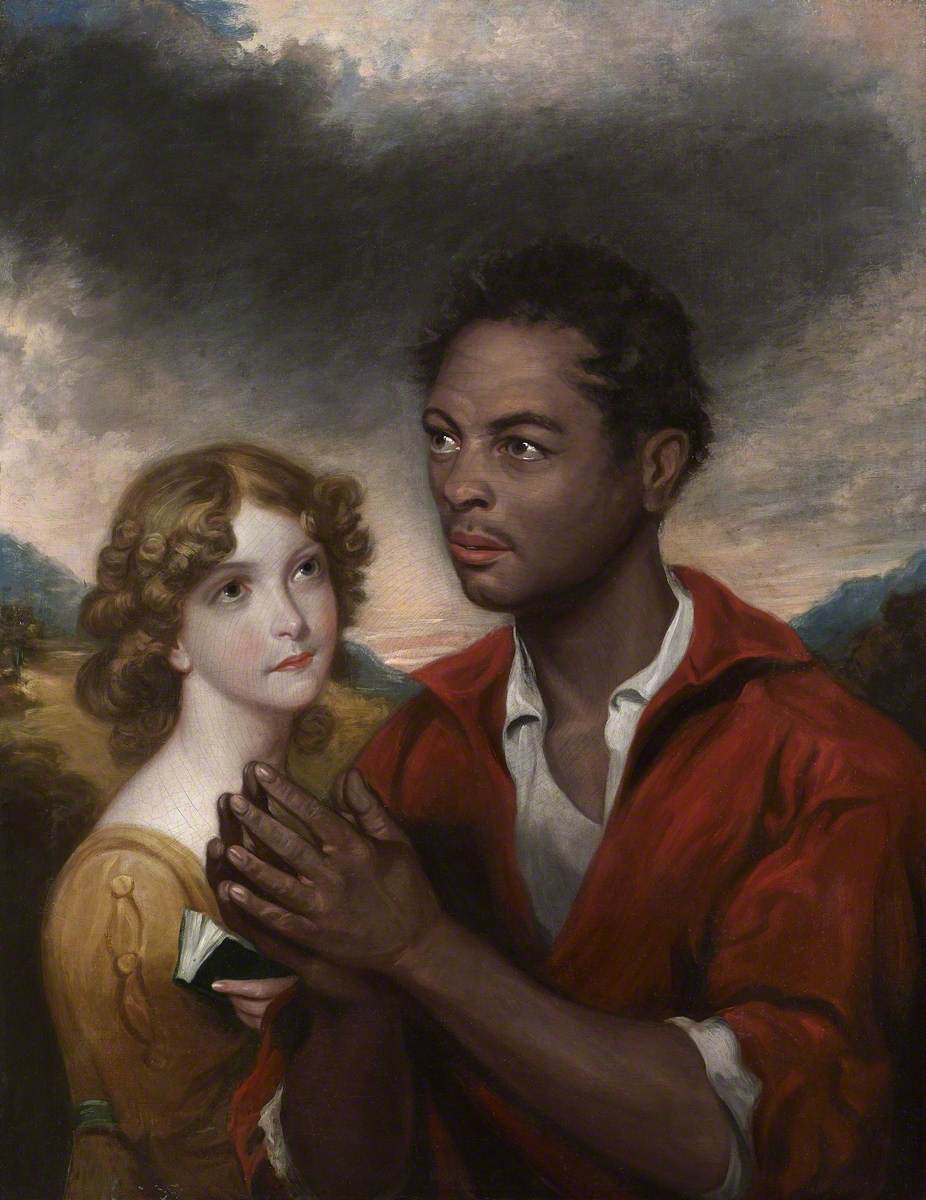
The Young Catechist


I had not previously been aware that the painting The Young Catechist by Henry Hoppner Mayer, now owned by Bristol Art Gallery

https://artuk.org/discover/artworks/view_as/grid/search/works:the-young-catechist

was actually an illustration to verses by Charles Lamb. Holding her Book of Common Prayer the white girl is instructing the African in the responses to the Anglican catechism, which will lead to his baptism.

In fact, now I look more closely, Lamb's lines were in fact a literary illustration to the painting.

both are lamentable productions, even if their aims were laudable,

However, both are useful examples of the racist aspect to Abolitionist sentiments and campaigns in the 19th century.

Here's The Young Catechist poem

While this tawny Ethiop prayeth,
Painter, who is she that stayeth
By, with skin of whitest lustre,
Sunny locks, a shining cluster,
Saint-like seeming to direct him
To the Power that must protect him?
Is she of the Heaven-born Three,
Meek Hope, strong Faith, sweet Charity
Or some Cherub? —

They you mention
Far transcend my weak invention.
'Tis a simple Christian child,
Missionary young and mild,
From her stock of Scriptural knowledge,
Bible-taught without a college,
Which by reading she could gather,
Teaches him to say Our FATHER
To the common Parent, who
Colour not respects, nor hue.
White and black in him have part,
Who looks not to the skin, but heart


Tuesday, 2 August 2022

Modern PR Visionaries UPDATE

STUDY DAY   #

 ##Modern Pre-Raphaelite Visionaries conference


In a Wood so Green, Frederick Cayley Robinson

Date: 9 September 2022

Location: Art Gallery & Museum

Time: 9:00 - 15:30

The conference is open to all, but will be particularly suitable for academics, museum professionals, students, and those with a prior understanding of the field.

Buy Tickethttps://warwickdc.ticketsolve.com/ticketbooth/shows/1173631030/events?TSLVq=c5e02205-112b-4f6c-b93c-2fe3405377aa&TSLVp=19f95679-919f-47db-a965-c4919c99c292&TSLVts=1659101088&TSLVc=ticketsolve&TSLVe=warwickdc&TSLVrt=Safetynet&TSLVh=a6acc4285ce38cefa05a769e4465b5a2

To celebrate our current exhibition, Modern Pre-Raphaelite Visionaries, British Art 1880-1930, Leamington Spa Art Gallery & Museum is organising a conference to explore the themes and ideas behind the exhibition and to examine the ongoing art historical legacy of this period in British Art.

This exhibition has offered the opportunity to re-examine a number of works by a host of ‘forgotten’ British Artists working at the turn of the twentieth century, whose work was inspired by the Pre-Raphaelite Brotherhood and European Symbolism, and who sought to understand their place in the changing modern world. It has allowed Leamington Spa Art Gallery & Museum’s important collection of work by Frederick Cayley Robinson, Simeon Solomon and William Shackleton to be contextualised by loans from across the country, raising the profile of these artists and their significance in the canon of British Art.

Please join us to discuss the life, work and significance of these artists on 9 September 2022 in person at the Royal Pump Rooms. The conference is open to all, but will be particularly suitable for academics, museum professionals, students, and those with a prior understanding of the field.

We are delighted to announce that Dr Elizabeth Prettejohn (University of York) and Dr Sarah Victoria Turner (Deputy Director at the Paul Mellon Centre for Studies in British Art/ Yale University) will be giving the two keynote presentations at the conference. They will be joined by Dr Alice Eden (Research Curator, Modern Pre-Raphaelite Visionaries Exhibition) who will be discussing her work on the exhibition. The full programme of talks and speakers will be announced in due course.

Lunch, tea and coffee will be provided

Proposed Schedule (subject to amendment):

9:00-10:00      Registration, tea and coffee

The exhibition will be open for viewing to conference delegates before public opening hours

10:00- 10:15    Welcome

10:15-11:15    Dr Elizabeth Prettejohn - Revaluations: Stories of British Art 1880-1930

11:15-12:15    New Voices: Presentations by two Early Career Researchers      

12:15–13:00    Lunch

13:00-13:30    Dr Alice Eden - Curator’s Introduction to Modern Pre-Raphaelite Visionaries

13:30-14:00    Break with chance to view exhibition

14:00-15:00    Dr Sarah Victoria Turner - “Cayley Robinson: a mystical modern”

15:00-15:30    Wrap Discussion

 Cost: £15 standard / £5 concessions including students

This conference has been generously supported by the Paul Mellon Centre for Studies in British Art. Modern Pre-Raphaelite Visionaries: British Art 1880-1930 has been supported by the Art Fund, the Garfield Weston Foundation, The Paul Mellon Centre for Studies in British Art, the Albert Dawson Trust and Friends of Leamington Spa Art Gallery & Museum