Tuesday, 22 June 2021

Emily Sargent

Emily Sargent view in Capri, n.d. Pitman Gift, Ashmolean Museum

 Sister to the more famous John Singer  -  how often is this sort of comment used in respect of women's art?  A small exhibition containing watercolours by Emily Sargent (1857-1936) is on display at the Broadway Museum, before transferring to the Ashmolean.  This nicely-chosen street view in Capri is one included, demonstrating the artist's accomplishment.

There's some degree of cant about the familiar lament regarding 'neglected' or 'forgotten' women artists, as if posterity were to blame.  But some [not all] did not seek attention, much less 'fame' or recognition.  They drew and painted for the satisfaction of so doing. If they exhibited, it was often in connection with some charitable endeavour, much like the embroideries and babies' knitwear contributed by others.    Emily Sargent was surely one such artist.

At the same time, she did not neglect or forget her artworks. It appears that some hundreds survive.  This group belonged to a member of her family, as did 37 others recently presented to Tate Britain [not yet online]. 

Wednesday, 26 May 2021

update


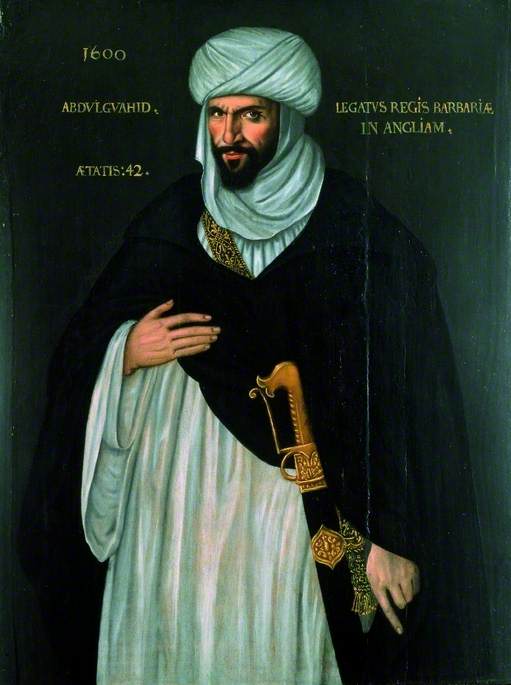
Al-Annuri – the Moroccan Ambassador

In 1600, there was a significant shift in England’s relationship with the Islamic world. Abd al-Wahid bin Masoud bin Muhammad al-Annuri was forty-two years old when he travelled to England as the ambassador of the Moroccan ruler, Mulay Ahmad al-Mansur. He was met at Dover on 8 August by members of the Barbary Company trading in Morocco, who took him and his retinue into London.

Abd el-Ouahed ben Messaoud ben Mohammed Anoun, 1600. © University of Birmingham Shakespeare Institute

Al-Annuri’s mission was to establish an Anglo-Moroccan alliance which would unite Moroccan Sunni Muslims and English Protestants against their common enemy: Catholic Spain. Al-Annuri’s proposal to Elizabeth was to invade Spain and reconquer Al Andalus (the mainland of Spain that had been under Muslim rule for centuries) and also launch a joint campaign against Spanish colonies in the Americas and Asia. Morocco was willing to supply the English fleet with provisions, infantry and money.

After being met at Dover, they travelled to London, arriving at Tower Wharf on 15 August. From there, they went to the household of Anthony Radcliffe, a merchant, on the Strand. Londoners observed, what they perceived to be, the Moroccans’ unusual dress and Islamic customs, including prayer. Then five days later, the Moroccans had their first audience with the Queen at Nonsuch Palace in Surrey. Clearly eager to impress, the palace was prepared with ‘rich hangings and furniture sent from Hampton Court’.

Sunday, 23 May 2021

DGR by Legros


Donato Esposito recently uncovered this chalk drawing by Alphonse Legros within the Slade School collection [where Legros taught] at UCL and correctly identified it as a portrait of Dante Gabriel Rossetti.  Comparing it  and especially the not yet entirely receded hairline, with the photos of DGR taken in October 1863 by Lewis Carroll [as he then wasn't] the portrait must have been drawn around the same season, Rossetti's first summer in Chelsea, when he frequently invited guests.   Legros was there on 16 July, for example, in company with Swinburne, Whistler and some other fellows.

In the Legros collection at UCL, mostly comprising etchings, are a few other unidentified sitters.  Some may have been studies, others look like portraits, whose names have been lost.  These two for instance


Tuesday, 18 May 2021

Louisa Waterford


a much-overlooked artist, not least because  her major work is on the upper walls of a village hall in far [depending where you are] Northumberland  but worth a big detour.     

Born into high society, her father being British ambassador to Paris, her elder sister married to Viscount Channing, Louisa fell for the dissolute Marquess of Waterford at the famous Eglinton Tournament and spent several years as a 'hunt widow' in Ireland until his lordship broke his neck in a riding accident..  

Louisa retired to Ford in the far north of England, where she built and decorated the hall with instructional images [not murals because they are on paper]. Lots of them, many using local people and local animals as models.


The Hall is now a free museum. Home page - Lady Waterford Hall (ford-and-etal.co.uk)


Monday, 19 April 2021

Racism 1880s


In a speech in 1888 prime minister Lord Salisbury referred back to the election of 1885 when the Conservative candidate had won the Holborn seat, saying that the winner had been  “opposed to a black man, and, however great the progress of mankind has been, and however far we have advanced in overcoming prejudices, I doubt if we have yet got to the point where a British constituency will elect a black man to represent them ... I am speaking roughly and using language in its colloquial sense, because I imagine the colour is not exactly black, but at all events, he was a man of another race". 

The defeated candidate was the Hon. Dadabhai Naoroji.

‘Few more unfortunate utterances have ever fallen from the lips of a British prime Minister’, began a Radical response published in the Pall Mall Gazette, the London evening newspaper. ‘It would have seemed unspeakably shocking to him to have sneered at the colour of a brother noble’s hair or even at a country squire’s freckles. These people are within the circle of the sacred caste. But to those who are without, the mere Irishry, the Hottentots, and Blackfellows generally, Lord Salisbury can be as rude as a bargee without ever dreaming that he is displaying a vulgarity of soul that is disgraceful to an English gentleman.

‘We see the same thing constantly in the case of slaveowners, and in a less degree the dealings of men with women.  A man loses caste for ever if he cheats another man at cards, but if he cheats a woman of her honour he is none the less received into society and indeed is regarded by many who would cut him dead if he cheated at cards as a very fine fellow indeed.

‘Now in Asia our myriad subjects have been made to feel that in the eyes of this proud patrician, who after all is but of yesterday compared with many of their ancient families, that they are all but “n*****s”.

‘Many a better man than Lord Salisbury has been a “Blackman”. Equally, it is true that many of our fellow subjects in India have skins swarthier in hue than our own.  That was also true in all probability of Christ and the Twelve Apostles …  The whiteman is the aristocrat of the world and he sums up his superiority in his own estimation when he sneers at the blackamoor.’

Salisbury's defence when rebuked was inimitably imperialist.  Claiming that the term ‘black’ did not imply contempt, he remarked that “The people whom we have been fighting at Suakim [sic, in Sudan], and whom we have happily conquered, are among the finest tribes in the world, and many of them are as black as my hat".   And, he went on, the House of Commons was too unique and “too delicate to be managed by any but those who have been born within these isles".  

In 1892, Naoroji was elected as MP for Finsbury.

The author of the letter in the Pall Mall Gazette and of its anti-racist views was a Dissenting minister named J Page Hobbs, who was based in Leicester.  According to Sydney Gimson, whose family owned the large iron foundry and engineering works there, his fellow middle class Radicals in the Leicester Secular Society were vehement Individualists in the wake of John Stuart Mill, but also decided to hear ‘the best that could be said for the new Socialism which was then rapidly coming to the fore.’  On consecutive weeks in January 1884, they listened therefore to H.M.Hyndman and William Morris, both from the newly-launched Social Democratic Federation, followed in the third week by J.Page Hobbs on ‘Sensible Socialism’. 

Gimson and his architect brother Ernest were greatly impressed by Morris, who gave what became his default speech on ‘Art and Socialism’.  It’s likely that current political events were also discussed, including the British military expedition against the Madhist uprising in the Sudan, on which Morris had forthright views.  When General Gordon was killed ‘defending’ Khartoum, Morris’s anti-jingoist comment was ‘Khartoum has fallen – into the hands of those to whom it belongs’.  That might have been too extreme for most of Leicester’s Secularists, by maybe not for Page Hobbs.

Hobbs is best remembered for a famous exchange that took place in the Gimsons’ home after Morris’s lecture.  ‘After supper we were talking about the lecture, Page Hobbs sitting in an easy chair, Morris on a dinner table chair,’ recalled Gimson. ‘Page Hobbs said, "You know, Mr. Morris, that would be a very charming Society that you have been describing, but it's quite impossible, it would need God Almighty himself to manage it!" Immediately Morris jumped up, ran his fingers through his hair and ruffled it, walked once or twice round his chair, then, shaking his fist close to Page Hobbs' face, exclaimed: "All right, man, you catch your God Almighty, we'll have him!" There was a burst of delighted laughter, in which Page Hobbs heartily joined.’ 

[ Sydney Gimson, Random Recollections of the Leicester Secular Society, March 1932, pp.20-23]


Thursday, 15 April 2021

The Rossetti Brothers' Seances


In the early 1860s  - a decade I have inhabited for some years now - much of British society was taken up and taken in by a craze for self-styled Spiritualist seances.   More or less serious endeavours o receive communications from dead relatives and celebrities, seances involved a darkened room, a moveable table and a group of which one member was identified as the 'medium', to whom messages were put.  Responses chiefly in the form of 'yes' and 'no' were typically received through raps or tilts heard and seen by all, from 'spirits'  who were initially identified through questions.

As a fashionable parlour game, this was harmless; for many it was proof [of a kind] of the existence of an afterlife as then promised by some varieties of Christianity that promoted 'reunion in heaven', now that traditional belief in heaven was severely compromised by geological and Darwinian thinking that quite destroyed the creationist view of the universe.  Seances as such were distinct from the wide Spiritualist movement, which claimed to apprehend an invisible realm beyond the terrestrial.  Messages from 'beyond' were eagerly sought by the bereaved.  It was wholly fanciful, though not wholly fraudulent - mediums could be as baffled as anyone about the nature of the apparent communications.

William Michael Rossetti, the level-headed, rational, atheist brother, was most involved in the seances.  Dante Gabriel was already intellectually sympathetic to occult and superstitious notions, but less persuaded by the mediums, professional or amateur, and indeed rather irreverent towards the spirits.  Possibly he felt real ghosts could do better than table-tilting and knocking.

William's records of the seances in various houses round London in 1866-67 read like the minutes of inconsequential meetings with motley participants.   Long known of from WMR's personal archive preserved by his daughter and descendants until given to Dick Fredeman and sold by him to the university of British Columbia, the full transcript of the Seance Diaries has now been edited by Barrie Bullen, for publication by Peter Lang.

The majority of the communications came from a spirit identifying as Elizabeth Siddal, who had died in 1862.  Sadly for posterity, she failed to reveal anything substantive about her afterlife, or even her previous life, and no details on whether her death was suicidal or accidental.  The Rossettis on one occasion communicated with their late father, but gave up [in some disgust?] when his spirit proved unable to understand or speak Italian - in life professor Rossetti seldom used English.

Also included with the Diaries is a completely crazy epistle from fellow artist Anna Mary Howitt to Gabriel Rossetti in 1856, which over 8000 rambling words offers a garbled version of Georgina Houghton's later exegeses of the Spirit's rhetoric, and illustrates the gravity of Howitt's psychic breakdown - surely not caused by but certainly coinciding with Ruskin's critical censure of her painting of the rebellious Boadicea. 

It remains the greatest regret that this canvas was destroyed, and that Howitt's earlier works, The Castaway and Gretchen at the Fountain, which apparently both sold, do not survive either.  And a pity that no spirits from beyond the grave offer to describe them to us.


Thursday, 11 March 2021

The Libyan Sibyl


 The Dean of Jesus College Cambridge has drawn my  attention to Burne-Jones's depiction of the  Libyan Sibyl in the extensive sequence of Morris & Co glass in the college chapel, to inquire if the portrayal was based on Fanny Eaton.  It's a good question, given that Eaton was the favoured model for numerous dark-skinned and exotic figures in the 1860s, and this design dates from the early 1870s.

But is there any evidence that EBJ used her as a model, or drew her in other guises?   I can't immediately find any.   

I incline to think that all the EBJ Sibyls, like most other figures in the window designs, are generalized images.   It's notable that the Libyan is dark-skinned, as pictorially befits a mythical figure whose role is (presumably) to serve the population of north Africa.  But I'd guess that EBJ's decision was prompted by the ten Sibyls on the floor of the duomo in Siena, where the Libyan is notably Black.


It is however, also interesting to note that another EBJ/WM window at Jesus College includes a second Black figure, in the person of Balthazar, the third Wise Man or Magus representing pagan Africa in the Adoration of the Kings.  


 It's true this Balthazar is not very dark.  But, together, the designs introduce a glimpse of diversity into an otherwise all-European  decorative scheme that purports to depict events in ancient Egypt and Syria.