Wednesday, 24 November 2021


As European portraits with African attendants go, this is a curious one. 
The main sitter Catherine-Marie LeGendre is shown pushing away the head of the enslaved servant while inviting the viewer to admire the bowlful  of exotic fruits he holds.

More usually, the exotic lad is shown  inviting us to admire the beauty of  the noblewoman who represents his owner [though  as he is as much an accessory as the fruit, he may well have been painted from any young African available to the artist].
The woman's gesture  compounds the discomfort we now feel when looking at such portraits from the age of slavery.    
Liverpool Museums, which owns the painting, have taken the decision to invite viewers to share their responses and opinions.   Here is the announcement.

'After being conserved, the only Lady Lever Art Gallery artwork from the 18th century depicting a person of colour takes new and prominent position in the gallery The Lady Lever Art Gallery is placing a painting featuring an enslaved African person at the front and centre of its displays. The oil painting of Catherine-Marie Legendre, painted about 1705 and attributed to Jean Baptiste Santerre (1658-1717), is the only item in the gallery’s collection, from the 18th century, to depict a person of colour. Following a period in conservation, the painting will be on display from 1 October 2021 in a new and more prominent place on the gallery, inviting comment from the public.  

'The painting will be displayed with a label which asks: “Does this portrait belong on the walls of the gallery today? Does its display help us tell and understand the history of slavery? Or does it continue to honour someone who benefitted from the slave trade? In light of recent international events, we want to know what our visitors think. We are displaying the portrait to be transparent with visitors and begin this conversation. You can share your thoughts with us by emailing BlackLivesMatter@liverpoolmuseums.org.uk.” 

'This disturbing portrait by Santerre is designed to impress by showing the sitter’s wealth and position in society. It shows a young boy, who is an enslaved African person, brought from a plantation to work as an unpaid house servant. He is wearing a decorative metal slave collar around his neck. His name is not known, but the sitter is Catherine-Marie Legendre (or Le Gendre, died 1749), the wife of French nobleman, Claude Pecoil (1629-1722), Marquise de Septème.  

'Catherine-Marie’s hand rests on the enslaved servant’s head to signify her ownership. It was not uncommon for wealthy white women to be painted with a Black servant in this way. In paintings, people of colour were used to highlight the paleness of the sitter’s skin, which was considered a sign of beauty. Often dressed in ornate outfits, enslaved servants were depicted in paintings as trappings of wealth. The boy is offering a bowl of rare and exotic fruit to Catherine-Marie to emphasise her life of wealth and abundance. 

Alyson Pollard, Head of the Lady Lever Art Gallery said:  'The Lady Lever Art Gallery is seeking to display, more openly, the Black histories and stories linked to the Transatlantic Slave Trade and its legacies which are hidden in the collections. Displaying a problematic and disturbing painting, like this, prominently and acknowledging its context is the beginning of a long term project to ensure our collections are not seen and viewed through a single historic lens but instead reflect multiple histories. 

'This painting by Santerre is unique in the collection, being the only representation of a person of colour from the 18th century. Unfortunately, not much is known about the boy in the painting, which is true of many of the enslaved men, women and children and the histories we try to document across our venues, particularly in the International Slavery Museum. The Santerre painting was previously displayed high up on a wall in the William and Mary room and under reflective glass. Its depiction of life for the very wealthy and of the injustices suffered by people of colour at this time make this a very striking image and one which we felt needed to be in a more prominent location.

'This intervention is one of several actions which the Lady Lever Art Gallery is taking in response to Black Lives Matter and the death of George Floyd. The gallery has updated its website to acknowledge Lord Lever’s activities in West Africa during the period 1911 to 1925 and has started the process of reinterpreting its collection, starting with a key work by Sir Joshua Reynolds painted in 1782 entitled ‘Mrs Peter Beckford’. The new text, as of February 2021, now recognises: “Peter Beckford, like many of his Beckford relatives, had plantations in Jamaica and the West Indies. The profits made from the labour of the enslaved people on his estates helped fund the Beckford’s lavish lifestyle.” The gallery is currently engaged in research into Lever’s legacy and is reinterpreting its collection to fully reflect the histories of the collection. 

'For more information on National Museums Liverpool’s response to Black Lives Matter see www.liverpoolmuseums.org.uk/blacklivesmatter.    '

The Liverpool collection also includes a rather better-known painting with a Black attendant. Painted by Zoffany in the 1760s, it shows the family of Sir William Young - such a cultured gentleman, with his daughters, dog, horse, cello and African lad to help with the children


Saturday, 13 November 2021

Rumplestiltskin by Georgie Burne-Jones


In 1860-1 when Georgiana Burne-Jones and Elizabeth Siddal planned to collaborate on an illustrated book of folk tales, Georgie produced some woodcut designs before the project was abandoned owing to Siddal's death.

One of the surviving designs is this illustration to story of  Rumplestiltskin,  from  what the Burne-Joneses referred to punningly as [W]Holy Grim[m].   The girl stitching is captive while the  grotesque creature on the left spins straw into gold, in exchange for her necklace, ring and finally her firstborn. Eventually she outwits him by discovering his strange name.

At first I didn't identify this as the Rumplestiltskin tale, as the demonic creature looks witchlike, and there's no visible straw.  But there is gold in the basket and Rumplestiltskin is plying a distaff rather than a spinning wheel as in most illustrations.

There is one print of the image, among Georgie's correspondence in the National Art Library with a letter dated December 1897.  And I'm pleased to have found its title at last.


Monday, 8 November 2021

Erased and Restored


Unknown artist, Frey siblings, 1837 

Circa 1837 painting of 3 Frey children in Louisiana and mystery boy (theadvertiser.com)

This portrait of three children from a family in Louisiana has an interesting and not all that uncommon history.  Painted in 1837, it originally contained four figures - the three white children from the Frey family and a tall African-American boy,  who at first sight looks like an older sibling


but who was in fact an enslaved domestic servant named Belizaire, then aged 15, according to  collector Jeremy Simien who now owns the painting. 
 
 Two decades later, Belizaire left the Frey household when sold on to the owners of Evergreen Plantation.     Some time after that, when the painting remained with the Freys, his image was painted over, presumably because slave owning ancestors had become an embarrassment.  

Belizaire remained invisible  when the picture -  attributed to  the artist J,G, Amans - was donated to the the New Orleans Museum of Art, and when it was de-accessioned.  The figure only returned to view when cleaned by a dealer and then offered for sale.

It's odd really, because the four figures balance the composition, and apart from skin colour, there's no indication that the tall young man is not an eldest brother.

Monday, 20 September 2021

Lucy and Cathy


Two significant artists were missing from my recent Pre-Raphaelite Sisters exhibition at the National Portrait Gallery.  Omitted owing to an already over-crowded cast-list, their absence was especially regretted as these two were literal not metaphorical sisters.

Half-sisters, to be precise.  Lucy and Catherine were  daughters of Ford Madox Brown, the doyen or daddy of the PRB, who declined to join the band because of its juvenile title, but who provided close support to the Pre-Raphaelite aims.


And so I am especially delighted that they feature in dual perspective in the Uncommon Power exhibition at the Watts Gallery Compton opening on 26 September.


Both produced modest but accomplished and original works, which are virtually unknown as they remain in private hands.  Descendants have been proud to retain the sisters’ pictures, according to exhibition curator Ruth Brimacombe.    So the new exhibition offers a rare opportunity to view hitherto unseen works by the ‘lost Pre-Raphaelites’ Lucy Madox Brown and Catherine Madox Brown.  


Lucy’s early work The Duet, (RA 1870) presents an unexpected 18th century scene with elements of chinoiserie, but her preferred subjects were drawn from drama and history – notably Romeo at the TombFerdinand and Miranda playing chess from Shakespeare and The Magic Mirror, from a legend about the Earl of Surrey by Thomas Nashe [at top].    All were marked by distinctive imagination and, especially, fine colour effects, they extend the Pre-Raphaelite canon in respect of both style and content.   The Magic Mirror (aka Fair Geraldine) is especially welcome – theme and handling wholly within the PR mode, yet the subject quite original.


Cathy’s companion portraits of her parents deserve wider circulation, although only that of her father is included in the exhibition.  She perhaps had more natural artistic talent, endowing portraits and contemporary genre scenes with visual interest and harmonies, yet more conventional subject choices. The child puzzling over the sum 9+6 on her slate in A Deep Problem (1875, BMAG) combines charm, observation and empathy.   At The Opera (1869) is a stunning take on the usually formulaic half-length female with decorative accessories.  Was Marie Spartali the model? 


 Curator and Gallery have made the most of the limited space available, with a richness and variety of exhibits, almost all unknown to viewers.  Moreover, the sisters’ relatively small output, together with its relatively high quality, make this first exhibition of their works a great chance to assess and indeed establish their place within the Pre-Raphaelite movement.  How do their pictures compare?  What adjustments to the critical history do they provoke? 


Friday, 27 August 2021

Evelyn de Morgan alert


A warning to scholars writing or thinking about Evelyn de Morgan's artworks: 
it appears that two items shown on the website of the De Morgan Foundation [DMF] as works by Evelyn are not and never have been by her, but should correctly be attributed to William de Morgan. 
 Like his wife, William trained as a painter, but fairly soon changed to the decorative arts, designing and firing the ceramic ware for which he is famed.

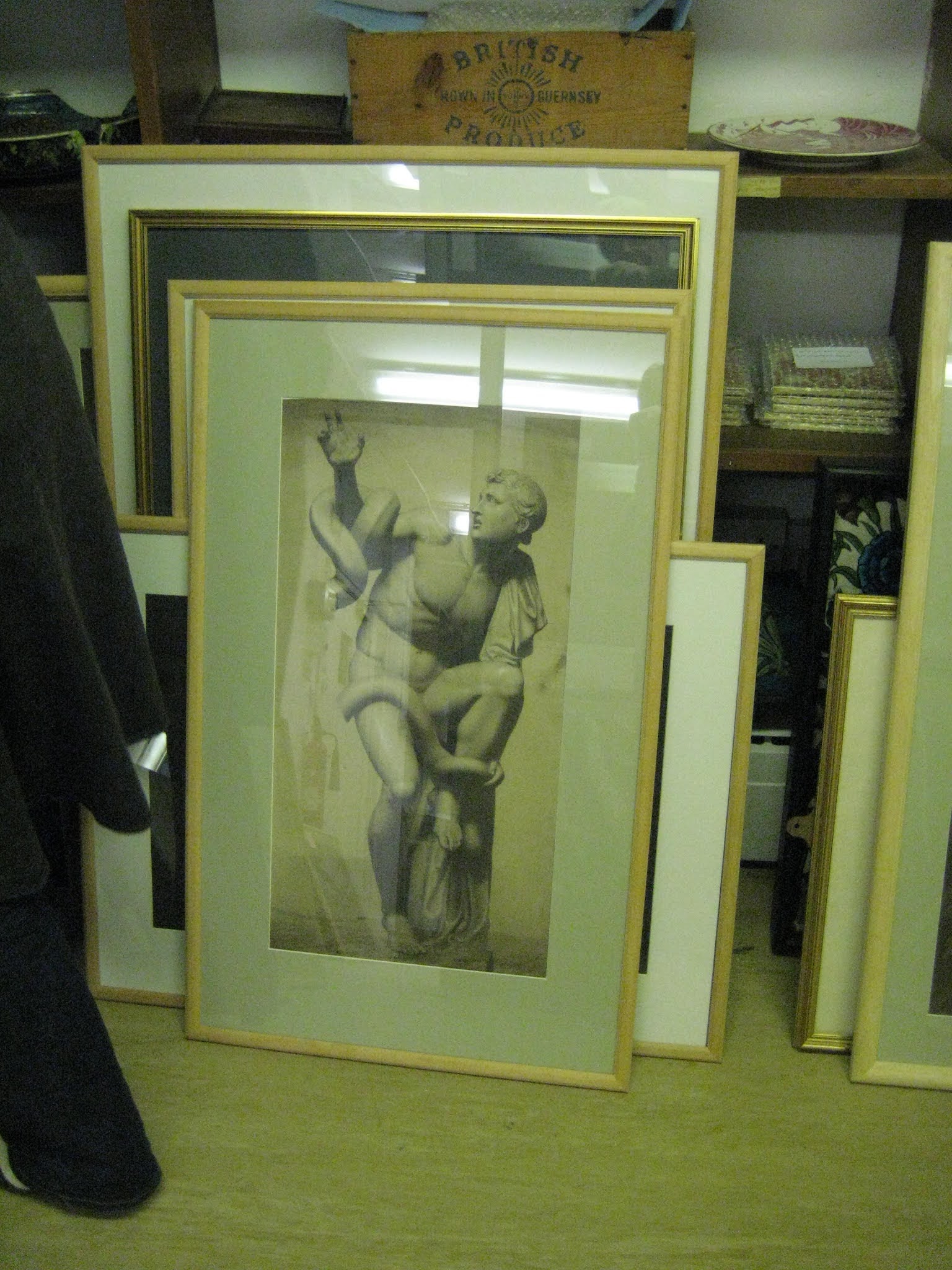
The first mis-attributed work is a student-style study drawing of part of the famous antique sculpture known as the Laocoon, showing Laoccoon and his sons wrestling  with a giant python.  Every art academy in Europe probably had a cast of this, and it was a   typical challenge to students.   If she did not  draw this study, Evelyn no doubt knew the piece well.  Its graphic style is similar to her careful depiction of e.g. the Discobolous cast, so the DMF error is only surprising if it has documentary info on the drawing which ought to have prevented the mistake.


The second work is the painting of Mercury, messenger of the gods, with winged ankles and helmet, holding s snake-entwined caduceus.  This is more problematic as it certainly resembles Evelyn's work more than William's, and neither its date nor full provenance are securely known. It was apparently acquired in 1910 by Wilhelmina Stirling, Evelyn's sister, when both William and Evelyn were alive, and will have known the correct authorship.

Such emendations to published information are an art historical hazard.


Monday, 23 August 2021

Maria Zambaco Sculptor


It felt good some years ago to track down in the storeroom of Georgetown University a delicately accomplished figure sculpture by Maria Zambaco, hitherto known only for a sequence of portrait medals in low relief. See 6 December 2017.


 It’s now clear there are several casts of L’Amour irresistible around the art market, indicating that it proved a relatively popular piece. Also that it dates from 1896, when it was on show at the Beaux Arts in Paris. in fact it’s possible to expand Zambaco’s known oeuvre quite substantially, thanks to now-easily-searchable sources and with the knowledge that from the late 1880s she also used her birth name, exhibiting as M.T.Cassavetti.

 Among the first exhibits at the 1886 RA (as M T Zambaco) she showed a terracotta bust of Alphonse Legros, the professor under whom she studied at the Slade School, and who perhaps encouraged the submission to the RA summer show, together with another work ‘Study of a Head’ that may have been a second bust, or a bas relief, as the medium is not specified. A new bust, listed as ‘Portrait of a Lady’ was at the RA in 1887, the same year as portrait medallion depicting Lily Langtry was executed - wrongly naming her 'Lydia'. 


 Then in 1888 came a bronze bust ‘Medusa’s Horror’, presumably with snake-filled hair and terror-filled expression. In 1889, as M.T.Cassavetti, she submitted two decorative works to the second Arts & Crafts Exhibition Society show at the New Gallery in Regent Street. One was a plaster ‘study for a house decoration’ and the other a ‘Tangerine fireplace’ cast by Enrico Cantoni, a London-based plaster moulder. 

By this date, she had partly relocated to Paris, to study under Auguste Rodin, sculpture doyen, and in 1889 exhibited at the Exposition Universelle a patinated figure entitled ‘Tentation’, which was accompanied by a case of portrait medals – possibly the same group that she asked Rodin to get forwarded to the Salon in 1890. ‘Tentation’ sounds so tantalisingly comparable to L’Amour irresistible that it’s a pity neither it nor most of the other works are located. 
 However, her portrait medal of Auguste Rodin Sculpteur, dated 1888, is to be found in the Musee Rodin, complete with a reversed ‘N’ in his name, which seems a surprising beginner’s error for an artist who was by now well-practised in medal-making.

So  Zambaco's output is shaping up to be more substantial than we thought.