Sunday, 13 September 2015

Italy 1430s


There is an interesting incidental remark by Lorenzo Valla, Italian scholar writing in the 1430s, where in a critical rejoinder to recently published theories on the supposed hierarchy of colour symbolism, Valla says

In my opinion, Ethiopians are more beautiful than Indians, for the very reason that they are blacker
[Et mea sententia Aethiopes Indis pulchriores, eo ipso quod nigriores sunt]

Leaving aside his opinion,  and the issue of pure versus mixed colour values, this sentence, dropped in an example or analogy, seems to indicate [a] that ‘Ethiopian’ was in general, or at least learned use, as a term for Africans, or possibly anyone with a very dark skin; and [b] that both ‘Africans’ and ‘Indians’ were sufficiently familiar in Italy for Valla to assume his contemporaries would instantly understand his point.  

Born in Rome around 1407, Valla had a rather peripatetic career owing to his critical opinions on papal power and in the mid-1440s left Italy first for Barcelona and then for Naples, before  being welcomed back to Rome and appointed apostolic secretary by a new pope.  So Valla could have been familiar with ‘Ethiopians’ in Spain or Italy.  But equally interesting is the fact that Valla’s patron during his wandering years was Alfonso V of Aragon and Naples, who as well as being a fairly aggressive ruler was a patron of the arts and a keen classicist, also had active diplomatic relations with the kingdom of Ethiopia.    According to Wikipedia, in 1428 Yeshaq I, ruler of Ethiopia, sent two envoys to Alfonso proposing an alliance against the Muslim forces, to be sealed by the marriage of Pedro, youngest prince of Aragon, to Yeshaq’s daughter – and requesting that neapolitan artisans be sent to Ethiopia as part of this deal.  The thirteen craftsmen despatched by Alfonso perished en route; several years later Alfonso wrote offering the new emperor Zara Yaqob another team of craftsmen if their safe arrival could be guaranteed, but, says Wikipedia, this letter probably never reached Ethiopia.


Ethiopia was of course a Christian realm in Africa that the Western church was well aware of – and the relationship with Alfonso V may indicate that Valla, who may have met Yeshaq's ambassadors,  meant ‘Ethiopians’ literally, not as shorthand for Africans.   

As it happens, there are portraits of two of Yeshaq's successors in the Uffizi, Florence, painted about a century after Valla's remark (the Uffizi works are careful, almost contempoary copies).  One is Lebna Dengel [aka Dawit II] who in 1520,  according to Portuguese traveller Francisco Alvares, was

 'a young man, not very black.  His complexion might be chestnut or bay, not very dark in colour: he is very much a man of breeding, of middling stature; they said he was twenty-three years of age and he looks that.  His face is round, the eyes large, the nose high in the middle and his beard is beginning to grow. In presence and state he fully looks like the great lord that he is.'

described on the panel:  ATANADI ∙ DINGHIL ∙ MAGNUS ∙ ABYSSINORUM ∙ REX/ VVLGO ∙ PRETEIANES APELLATUS ∙ 1532 [Atanadi Dinghil the Great King of the Abyssinians/ Called Preteianes by the People 1532

It is not clear where the likeness of Lebna Dengal was drawn from; Paolo Giovio, who commissioned the whole series of famous men to which this work belongs, is known to have written all over Europe and the near East soliciting portraits, so it is possible it is based on a drawing, though it looks as if confected in accordance with contemporary portraiture with some reference to Alvares' description.  The second Uffizi work labelled as an Ethiopian emperor is that of Alchitrof, which seems more or less completely fictive, even if the physiognomy depicted is recognisably 'African'.  it would be interesting to discover who the original artist and patron thought the sitter to represent, and what the empty frame  he holds was intended to signify. 

.

Friday, 11 September 2015

Black Chronicles II / 2


The collection of photographic images depicting sitters of African ancestry in Britain in the Victorian era that is one part of the ABP Autograph project is now on view at the  Emanuel Cooper Gallery attached to the Hutchins Center, Harvard University in Cambridge MA.
The shot above shows two young South Africans who travelled to the UK with the African Choir in the 1890s.   The choir was photographed by the London Stereoscopic Co., and it looks as if these two may have been so intrigued by the whole process that the photographer used their curiosity to pose them trying out his job.   Their names were John Xiniwe and Albert Jonas, which suggests they hailed from the Transkei and Cape respectively.

Many of the Black Chronicles images, drawn from the Hulton/Getty archive,  are visually arresting, not least when they are enlarged to sizes impossible in the 19th century, with no loss of detail or quality, so good were the originals.  The exhibition runs until  11 December and then transfers to Spelman College Museum of Fine Art in Atlanta. I look forward to seeing how the installation looks and compares with its appearance at INIVA in London last year  - see earlier post 12 months ago.

For more information  see also
Autograph ABP is an ongoing research, events  and exhibition project - more here 

Sunday, 6 September 2015

Vanley Burke @ IKON


Photographer VANLEY BURKE has for years created a visual chronicle of experience in Birmingham since the mid-60s.   He has also collected items of political, personal and decorative interest and is a dedicated archivist of objects relating to Black people in Britain, from china tea cups to slave shackles, piles of  magazines and postcards to coats, hats and shoes. 


For the past two months, the entire contents of his apartment in north-east Birmingham have been re-displayed in the Ikon Gallery, providing a vivid sense of being 'At Home with Vanley Burke', in sitting room, work room, kitchen, bedroom.   Every object is a story - engaging, polemical, nostalgic, fortuitous, musical, angry, comical.  Visually and spatially it is literally fascinating, every eye-ful yielding different juxtapositions - with vinyl playing on the ear as well.


Burke's words provide the intellectual and historical context:
"I am informed by my desire to capture people's experience ... History always has a starting point, but we, the African-Caribbean community, didn't trust the history that was written ... we needed to start documenting and writing our own history, so I collected material that reflects us .... It was all about the process of migration and settlement .  I was conscious that while you're doing that you don't have time to record your own history or see what's happening around you. My role as artist was to observe and document thee things ... I'm also interested in mass-produced objects  - the paraphernalia that was used visually to describe black people: figurines, masks, golliwogs. Although they were not owned by us at the time, they are still part of our narrative.  It's about the process of collecting objects which are pregnant with the history of the people who have used them.  A black experience, but largely a working-class experience as well." 

Wednesday, 26 August 2015

Marie Spartali Flower Painting.


As well as beguiling landscapes, flower painting was another genre that Marie Spartali successfully pursued throughout her career, images which contrast with the delicacy of much of her work by being, in the words of a contemporary, ‘forcible and decisive’ – terms that are seldom applied either to her work or to flower painting in general.

As more or less the lowest genre of art, flower painting has been consistently disregarded and dismissed, except when it appears in seventeenth century Dutch examples, or in works by Van Gogh.  But down the centuries flowers have been among the most popular of subjects and certainly one that appealed to women artists who had less access to travel, to professional models, fully equipped studios or wealthy patrons.

As flowers droop, fade and drop their petals very swiftly, flower painting requires a special set of skills which often go unremarked.  In the 1860s Marie Spartali’s father bought at least one still life from Henri Fantin Latour which is now in the Metropolitan Museum.  Showing lilac blossom and white stocks in a black vase, alongside apples and pears – an unseasonable combination – this rather stiff piece may have inspired Marie when in the mid-1870s she sent several flower pieces for exhibition, in the UK and US.  They included a group of chrysanthemums and hellebore; pairings of roses and lilac, roses and lilies, roses and honeysuckle; and two wild flower subjects, ranunculae (either celandine or buttercups)  and kingcups with blackthorn.


All are apparently untraced;   the flower paintings that are known and thus available for exhibition at Delaware Art Museum seem to date from much later in Marie’s career.  As they remain in family possession they may have been done for her own satisfaction rather than for sale, a guess that is supported by the fact that several are undated.   We have chosen subjects reflecting spring, summer and autumn, and they add a vigorous, colourful dimension to her oeuvre.

CATALOGUE DETAILS HERE


Sunday, 2 August 2015

Marie Spartali and the Etruscans


As well as revealing Marie Spartali’s serious and successful exhibiting career in the United States, research for the forthcoming Poetry in Beauty exhibition at Delaware Art Museum (see post for 14 March) has discovered her very fine, atmospheric landscape painting.
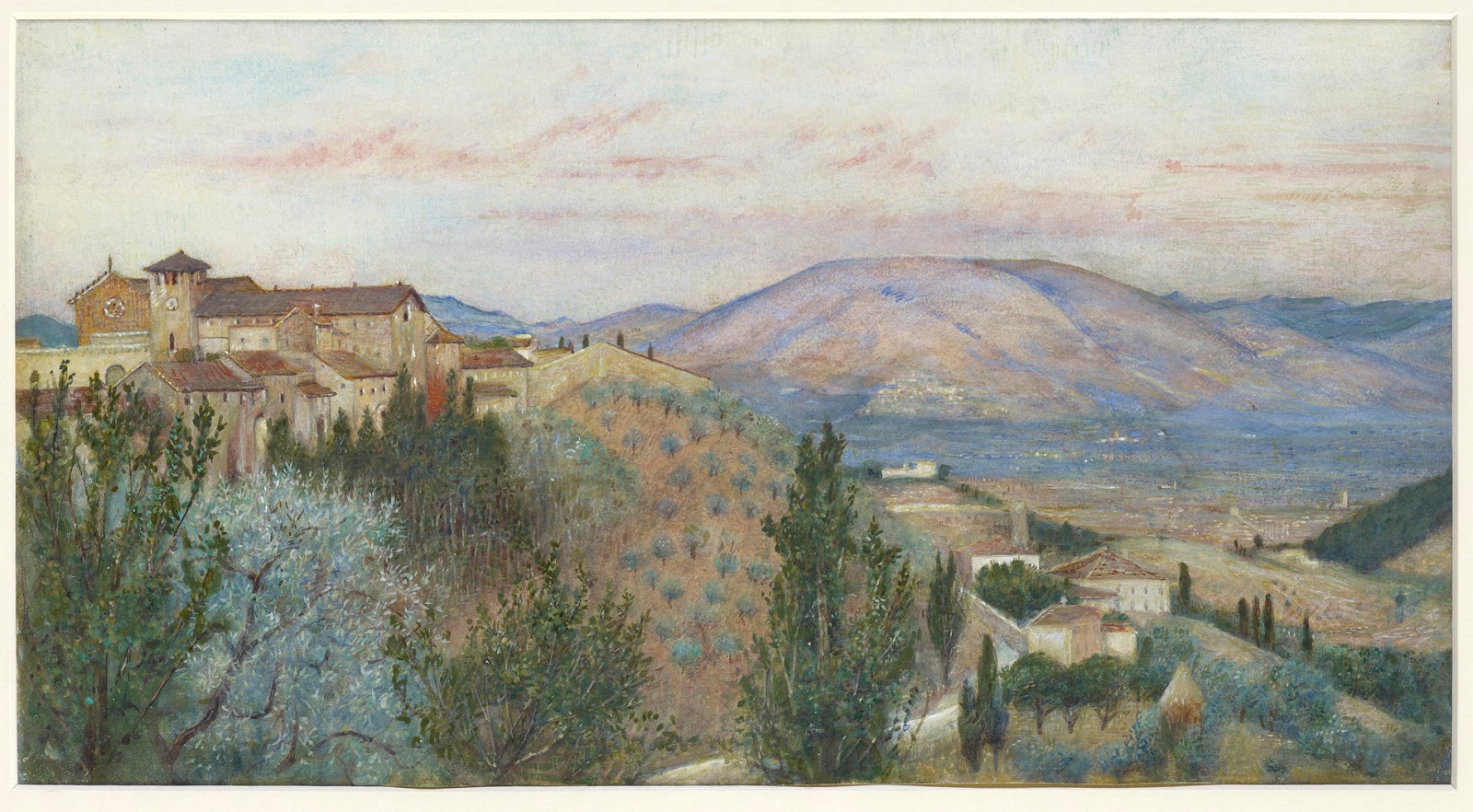
Monte Luce from Perugia; private collection 
Hitherto known chiefly for ‘Pre-Raphaelite’ female figures, embowered in flowers and foliage, this aspect of her art, pursued throughout her life, deserves greater scrutiny.  Her earlier landscapes tended to depict scenes and location on the Isle of Wight where the Spartalis had a summer residence (now the barely-altered Rylestone Manor hotel).  Later, after she moved to Florence and then Rome, Italian landscapes naturally featured.  The 1890s saw a strong and striking development linked to Marie’s acquaintance with the group of artists now known as ‘the Etruscans’, which was headed by Giovanni (Nino) Costa and also attracted several British and American painters, including Frederick Leighton and Edith Murch Corbet.   
These artists, many of whom exhibited with Costa’s  In Arte Libertas shows from 1886 to 1900, remain understudied although not wholly neglected.  Rather than the familiar warm sun of  the South, their art  favoured a cooler light, typically that of early spring and early morning, wide horizontal views and gentle, often unremarkable vistas.
Spartali spent at least one memorable season alongside Costa while staying in Perugia, guest of fellow artist Lemmo Rossi-Scotti.  Costa’s habit, which Marie doubtless copied, was to rise and dawn and paint out of doors till mid-morning, resuming in late afternoon until dusk, partly perhaps to escape the mid-day heat but also in pursuit of evanescent atmospheric effects.  There were day-long excursions too, mixed in with appropriate reading from Italian sources, notably those relating to St Francis of Assisi, just 25 km from Perugia.  
Lago di Nemi; private collection
 Back in Rome, Spartali visited the famous Lake Nemi, once sacred to Diana or Artemis, depicting it in soft, pearlescent tones, and also sketched with Costa by the ancient Ponte Nomentana.   These are among the most delicate and evocative of her landscapes.  Other favoured scenes included light-filled woodland in spring, with slender trees vouchsafing a distant view of hill or hill-top town.   Often, but not always, she added figures to the landscape.  These provide scale and human interest, which was maybe chosen to appeal to buyers, for Spartali was always a professional artist with an eye to exhibition and sales.  Several of the scenes suggest however that her main pictorial interest lay in the skies, and the desire to capture their subtle atmospheric effects at different times of day.
Ponte Nomentana; Morgan Library & Museum NY

Monday, 13 July 2015

Keir Hardie by Sylvia Pankhurst


by Sir Leslie Ward for Vanity Fair, 1906
Another Socialist hero was the Labour leader Keir Hardie, the centenary of whose death this year might prompt reflection on the party’s fortunes.  It was Hardie who led the first substantial contingent of Labour MPs in the early 1900s and who helped change both the image - from top hat to cloth cap - and the content of British politics.

“From now until November the National Portrait Gallery presents a selection of portraits of the first leader of the Labour Party in Parliament, James Keir Hardie (1856-1915), to mark the centenary of his death on 26 September 2015. During his comparatively short fifty-nine years Hardie was a miner, a trade unionist, a journalist, an editor, a Member of Parliament and an anti-war campaigner. A key figure in the creation of the Labour Party as a political force, Hardie helped to radically alter the political landscape of Britain. Unique in his ability to speak directly to and for the industrial working-class in the late Victorian and Edwardian eras, he was committed to ethical socialism, to the political independence of Labour and to women’s suffrage."


The NPG possesses two portraits of Hardie by Sylvia Pankhurst, Socialist, Suffragist and artist. Drawn in the final years of his life, they sadly record a prematurely aged figure, but  Pankhurst’s words testify to the significance of his life’s work.  On his death she described him as 'the greatest human being of our time' and in offering her larger image to the NPG she wrote that his place in history was important. 'I am conscious that this is only a sketch and was purely a preliminary study to assist me to do a painting.  I should not have ventured to offer it to the the National Portrait Gallery save for the fact that I believe you have no other portrait of Keir Hardie.  I think it does give an idea of the kind of man Keir Hardie was'.

On 3 September, Melissa Benn (whose late mother Caroline Benn wrote Hardie's biography) will be in conversation with Keir Starmer MP, in the NPG lecture theatre. 

Sunday, 12 July 2015

WMS @ 60

WMS @ 60

THE PRESENT WILLIAM MORRIS SOCIETY, successor to earlier groups and fellowships, was launched in 1955 to celebrate his life, works and continuing impact on politics, design, conservation, crafts and critical thought.  
For a single, long-dead, bearded Victorian, William Morris’s ideas have enjoyed an astonishing multifarious afterlife, and the diamond ( = enduring) anniversary of the Society is being marked this 5 September with a whole-day symposium William Morris in the 21st Century.  
The focus is on radicalism and future perspectives regarding political action, environmentalism, education, utopian designs and human relations with the natural world. 


Details of when and where are on the attached pdf .  Everyone is welcome to what is hoped will be a stimulating day of discussion and debate.  There are many points of contact between the turmoil of Morris’s time, before the formation of any Labour or Communist parties, and that of today, when new approaches to local and global situations are being formulated.

 This is part of my introduction to the day:
WM's life and ideas remain startlingly in fashion, in quite disparate ways.   Last month the Daily Telegraph listed his bedroom at Kelmscott Manor among its top 50 ‘Hidden Gems’; and in July  Country Life celebrated 60 things it declared ‘the best of Britain’.  Grouse moors, tea at the ritz, hunting horns and the monarchy. Then, flanked by public schools and parish churches, was WM wallpaper, his instruction about what to have in your house and the declaration that the Arts and Crafts movement was ‘part of a wider socialist vision for moral improvement and wholesome living,’ that still inspires today. And so he is beloved even by the reactionary press.
Just weeks earlier, a leader column in the Guardian written by Charlotte Higgins proposed WM’s ‘splendidly bearded visage’  for the new £20 note.   She argued:
‘Morris would be a hearteningly radical choice, despite the chintzy reputation.  Stanley Baldwin might have failed to mention Morris’s politics when he opened the V&A’s centenary exhibition in 1934, but … he was a revolutionary socialist who wrote and lectured tirelessly, who addressed the striking miners of Northumberland in 1887, who marched on Bloody Sunday to Trafalgar Square. He wished to see a world in which there were neither “brain-sick brain workers, nor heart-sick hand workers … in which all men would be living in equality of condition.”  Of course there were contradictions in this revolutionary-cum-luxury-retailer. But these would be elegantly encapsulated by his gracing the currency. In short, Morris was, “one of those men whom history will never overtake”.
 This all might make one suspect that WM is ‘all things to all men’  – somewhere we can each find confirmation of our likes and dislikes, prejudices and preferences.   But I think his legacy is more stimulating and provocative.  One cannot like everything that WM said or produced; indeed, one must often argue with his politics and his patterns. 
 And it is something of a mystery to me why the Society founded to promote the contemporary relevance of his life and work (to quote the recent business plan) has not over six decades split into constituent strands or sects – some to celebrate stained glass, others to debate anarcho-syndicalism; some to study the Sagas, others to build new cities;  some to analyse utopias, others to print beautiful books.   There are these tensions and complexities as there have been ever since Morris’s time, at least, when Bernard Shaw divided the progressive movement between those idealists who wished to sit among the daisies and those who wished to organize the docks.  But the Society has room for all in a spirit of diversity within commonality.
 Above all, WM’s legacy remains powerful  because we do not regard it as primarily  historic.   It belongs to the present and future as well.  Recently I was invited to a symposium, on the theme ‘Would WM have used an i-pad?’    Well, it’s an interesting question with a less simple answer than might at first appear.  

While I think that i-pads will possibly have a fairly short life-span, owing to the speed of change in an electronic, digital and frankly astonishing age, we must also contemplate ‘how we live and how we might live’.