Friday, 23 May 2014

MINOAN TREASURE HOUSE


heraklion archaeological museum

THE NEWLY-OPENED Archaeological Museum in Iraklion / Heraklion, Crete is stunning.

We were lucky enough to visit on its first day – as we later discovered – I wondered why there were staff members in clusters as well as attendants in the galleries – and the wealth of Minoan objects from all phases and sites, lucidly displayed with informative wall panels but as yet few individual labels, was rewardingly wonderful visually and intellectually.
  
The galleries are spacious and excellently lit, with many larger exhibits on open display, and the others in cases of such high-quality glass that it creates no reflections and seems virtually invisible – occasionally hazardous but brilliant to behold.  I know zero about Minoan history and culture beyond the popular notions of bare-breasted deities and bull-leaping athletes, so was unprepared for the amazing egg-shell-thin ceramic cups and bowls, tapering vessels and decorated dishes. 
Most of the now-questionable reconstructed frescoes are placed in an upper gallery, preserving the images by which Knossos has been best known but clearly showing how fragments were imaginatively and freely interpreted by the infamous Arthur Evans.  

Also wonderfully, photography is allowed for all already-published exhibits, although the numerous other  off-limits items indicates how much previously unseen material is now available for visitors as well as scholars.  In some ways the lack of labels was an asset, enabling one to just look and look.  

And this summary barely scratches the surface of the wealth of items in room after room, offering continual interest and indeed requiring a second visit – incidentally not at all expensive especially on a combined ticket with Knossos – which is extraordinary in its own, sadly trashed state.  In fact, since its finds are safely in the Museum, the loss of Knossos both to the original excavations, rebuilding, concrete additions and general degradation, and to the ongoing destruction by thousands of daily visitors, seems a worthwhile sacrifice, preserving other sites like Phaistos and many other as yet unexcavated Minoan locations from the tramping hordes.    

Saturday, 3 May 2014

Whitechapel Lads


exceptionally interesting post from the Gentle Author about the archive of late-Victorian glass plate photos of young men at the Working Lads Institute in Whitechapel, including three young Londoners of African ancestry and a similar group of recruits in 1914:

http://spitalfieldslife.com/2014/05/03/whitechapel-lads/#comments

interestingly, several of the  non-African sitters were photographed on the roof, standing in front of sheets strung up by chimney stacks and a drying shed; they are shown full-length, whereas the black boys are half-length close-ups, apparently indoors.  It would be interesting to know if these pictures were ever published, if any prints survive, and what their original purpose was.

This group portrait is currently on view until the end of August 2014 at an exhibition organised by Tower Hamlets Community Housing, 285 Commercial Rd, E1 2PS, together with many other portraits of World War I combatants from East London,  including Walter Tull.

Thursday, 1 May 2014

Jenny Morris at Over Stowey


When she died in July 1935,  Jenny Morris, her life sadly ruined and wasted by epilepsy, was living in the parish of Over Stowey, underneath the Quantock Hills.  Despite her disability, she survived to age 74.

Over Stowey church has several windows  by Morris & Co., including a relatively early (c.1870)  Annunciation designed by Burne-Jones, four of Morris's charming Musical Angels, four larger, less charming ones with over-large wings, and three late figures of Faith, Hope and Charity.  They would seem to have been commissioned by the local landowners, the Stanley family, but I don't know what the Stanleys' connection to Morris & Co., or any of the Firm, may have been; and one assumes that Jenny's residence there many years later was coincidental [owing to debilitation and seizures, she required constant care, and her income paid for a series of rural homes of this kind].  But I just wonder if there was a connection.  If anyone has information, please let me know  

SEE BELOW 

And one incidentally hopes that her impaired health nonetheless allowed Jenny  to enjoy Over Stowey village and flower-filled churchyard, as well as the Annunciation window made in the workshop behind the family home at Queen Square, when she was young and full of promise.


Frank Sharp has the answer:  Lord Taunton of Quantock Lodge purchased one of the First Morris & Co productions, the Backgammon Players cabinet, exhibited at 1862 exhibition. 
 One of his daughters married a Stanley, and  maybe was still living in Somerset when Jenny moved there.

Wednesday, 23 April 2014

Black boys in green jackets and purple caps


The big new VERONESE exhibition at the National Gallery is my opportunity to check out Ruskin's distasteful jokes during the US Civil War - that in his view the main purpose of Negroes was to be painted by Veronese, and his unamusing request  that Charles Eliot Norton send him 'something American - a slave perhaps. I've a great notion of a black boy in a green jacket and purple cap in Paul Veronese's manner.'

 Those who admired Ruskin's tremendous description of Turner's 1840 picture Slavers Throwing overboard the Dead and Dying—Typhoon coming on :  as 'the noblest sea that Turner has ever painted':
 "It is a sunset on the Atlantic after prolonged storm; but the storm is partially lulled, and the torn and streaming rain-clouds are moving in scarlet lines to lose themselves in the hollow of the night. The whole surface of sea included in the picture is divided into two ridges of enormous swell, not high, nor local, but a low, broad heaving of the whole ocean, like the lifting of its bosom by deep-drawn breath after the torture of the storm. Between these two ridges, the fire of the sunset falls along the trough of the sea, dyeing it with an awful but glorious light, the intense and lurid splendor which burns like gold and bathes like blood. Along this fiery path and valley, the tossing waves by which the swell of the sea is restlessly divided, lift themselves in dark, indefinite, fantastic forms, each casting a faint and ghastly shadow behind it along the illumined foam. They do not rise everywhere, but three or four together in wild groups, fitfully and furiously, as the under strength of the swell compels or permits them; leaving between them treacherous spaces of level and whirling water, now lighted with green and lamp-like fire, now flashing back the gold of the declining sun, now fearfully dyed from above with the indistinguishable images of the burning clouds, which fall upon them in flakes of crimson and scarlet, and give to the reckless waves the added motion of their own fiery flying."
certainly expected him to be an Abolitionist.  Far from it; perhaps influenced by his own admiration for Thomas Carlyle and certainly by his political conservatism, Ruskin did not oppose slavery, and indeed at the height of the US Civil War stopped writing to his old friend Norton, an active Emancipation  campaigner.

Lest Veronese be co-opted into this argument, it should be said that Ruskin's remarks followed his aesthetic conversion away from the pious calvinism of his upbringing to a warmer valorisation of physicality  thanks  to "the mighty Paul Veronese, in whose soul there is a strength as of the snowy mountains, and within whose brain all the pomp and majesty of humanity floats in a marshalled glory, capricious and serene like clouds at sunset - this man whose finger is as fire and whose eye is like the morning..."

So what of the black boys in green jackets and purple caps?   In the fifty works in the NG exhibition, there are indeed quite a few figures of unmistakeably African ancestry, though some are not immediately discernible and nearly all are marginal onlookers or servants, whose colouring may have been their chief pictorial purpose.  The exceptions are naturally the third king in the Adoration of the Magi,  his appropriately Ethiopian attendant, 
and the equally appropriate local young man who has found Moses' cradle in the Nile and  handed him over to the apparently European daughter of Pharoah, as in this detail from the version from the Prado : -


The Martrydom of St George - lower half only here - has a lad in green acting in support of George's executioner, though he could conceivably be trying to restrain him. 


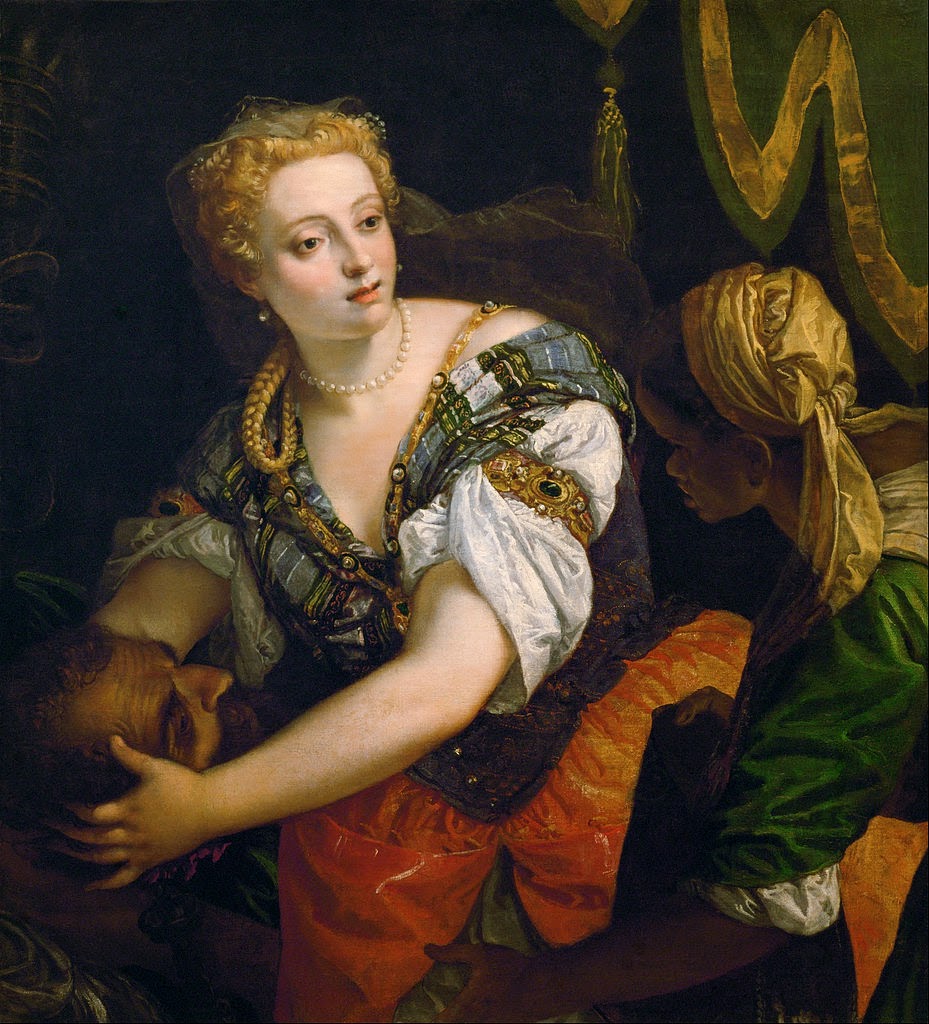
I didn't see any black boys in purple caps (Ruskin must have had other paintings in mind) but I am also interested to note the ethnicity of Judith's maidservant and accomplice in Veronese's account of the decapitation of Holofernes, as at the top of this post. She is also clad in green.  Veronese was living and painting in Venice in the 1570s and 80s when these pictures were produced; so one assumes that black servants were common figures in the city, available to fill pictorial roles along with  nobles, merchants and courtesans.

The same cannot have been true of other characters who jostle and gesture in these busy, vigorous scenes - namely the many angels and cupids who act their allegorical roles so convincingly, rising and floating and swooping with airborne realism, here lifting a saint to heaven, there dropping an episcopal hat on St Nicholas, even carrying a plump putto in the crook of an arm.

The pictures are confidently tremendous, as is their staging in the large top-lit galleries with grey or maroon walls.  Nearly all are large and designed to be viewed from the floor at a distance, so in the spacious rooms one can stand back and look, as at a cinema screen, taking in the composition wholly and severally, in a  very comfortable viewing experience.  When desired, closer brushwork scrutiny  is equally not impeded by a queue of other viewers.  And there are many other topics to ponder besides servants and angels.  Check out the animals, too.


Sunday, 6 April 2014

Am I Not a Man


an interesting post from SEAN CREIGHTON  http://historyandsocialaction.blogspot.co.uk

Did Thomas Bewick Design 'The Kneeling Slave - Am I Not a Man and a Brother''?


An astonishing find was made this winter in a Northumberland field next to the 18th-century George Hotel at Chollerford, – part of the bowl of a clay pipe with the ‘Am I Not A Man and A Brother image’ on it. (www.thejournal.co.uk/news/north-east-news/clay-pipe-discovery-northumberland-field-6681854). It was found by Ron Brown of the North East AAG Archaeology consultancy (aag_arch@hotmail.com).

This finding is significant because it suggests that the Gateshead area pipe makers were using the famous image which is most associated with the potter Josiah Wedgewood. It is a small indication of the degree of support for anti-slavery across the classes in the North East as shown by the work in the 2007 Tyne & Wear Remembering Slavery Project. But it could have more significance if, as I have been arguing since then, that the image was based on a design by Northumberland engraver Thomas Bewick, a known supporter of the anti-slavery movement. The pipe could therefore be an artefact representation of perhaps the North East’s most influential and powerful contribution to the anti-slavery movement, which finally found its success in the abolition of slavery in the British West Indies under Northumberland’s Earl Grey’s Government in the 1830s.

When designing its 2007 commemorative badge the Great North Badge Company states that its ‘inspiration … is taken directly from Wedgwood's medallions. The badge's ornate belt border being based upon a contemporary engraving by the well-known artist Thomas Bewick.’ (www.nelson-trafalgar-badges.co.uk/Abolition%20of%20Slave%20Trade%20-%20Bicentenary%20Badge%20Issue.htm).

Bewick's Full Engraving

A full engraving by Bewick sets the kneeling slave in the plantation background and it was reproduced in John Sykes Local Records collection of events in Northumberland and Durham. Thomas Hugo's 1866 book 'The Bewick Collectorcontains the following note written years before by the North East collector John Bell: “Bewick took a deal of pains with this cut. It was done for a Society in London and Newcastle, 1787, in which there were Sir John E. Swinburne, Mr. Thomas Bigge, and others, who were particular friends. It has since been much hacked, by being used for everything which had any allusion to Negroes or the Slave Trade....” While this is not conclusive, it suggests that there may be a strong case for Bewick being the designer of the image for the London Society’s seal in 1787, which was then quickly interpreted by Wedgewood’s designers into the jasperware medallion in the same year. The reference to a Society in London and Newcastle in 1787 is perplexing, because no evidence has been found for the existence of an anti-slavery society that year in Newcastle. The Newcastle Society was not established until 1791. There may have been an informal grouping of anti-slave trade supporters because Newcastle Corporation was to submit one of the first petitions from the provinces to Parliament in 1788. That was the year Swinburne became an MP.


Mediallion Version

A medallion style version of the kneeling slave with plantation background was used on the front cover of the printed play Princess Zanfara by William Hutchinson a solicitor, antiquarian, and freemason based at Barnard Castle published in 1789. Another version was used for the tract published in December 1791 by the newly formed Newcastle Anti-Slavery Society giving details from the inquiry into the slave trade by the House of Commons. In discussing this in his book Popular Politics and British Anti-slavery: The Mobilisation of Public Opinion John Oldfield writesBewick’s interpretation of the London Committee’s seal gave fresh life to what was by now a familiar image.’ The image went on being used in Newcastle publications to 1830.

I have an image of a page of a printed publication showing both of these images which discusses both the 1789 and 1791 images. ‘We learn from John Fenwick, Esq, of Newcastle, that Thomas Bewick engraved two cuts of the Negro kneeling. One of these was cut for an Abstract of the Evidence given in reference to the Slave Trade .. published at Newcastle and the other for the “Princess of Zanfara” …Fenwick was one of the Secretaries of the Newcastle Anti-Slavery Societies and donated many of his anti-slavery tracts to the Newcastle Literary & Philosophical Society. Given the massive number of notes taken in the 2007 Project I unfortunately cannot link the image of the page to the reference to the publication this was printed in. This appears to confirm that medallion images reproduced in Newcastle publications were by Bewick.

Raising the Question

I first began to raise the question of whether Bewick is the original designer of the kneeling slave image, and whether Wedgewood took his inspiration from Bewick, when I was Archival Mapping & Research Officer for the 2007 Tyne & Wear Remembering Slavery Project. I shared the idea with a wider audience in my talk on slavery and abolition in the North East at the 1807 Commemorated Conference at the University of York held in September 2008, and in January 2011 in my talk at the British Society for 18thC Studies Annual Conference at Oxford University.

I asked Jenny Uglow, author of the superb biography of Bewick Nature’s Engraver, whether she knew anything about it, but she did not.

Bewick, who financially subscribed to the abolition cause in 1792, had a clear moral philosophy and supported radical causes throughout his life. But he was not an organiser. He was one of the hundreds of supporters whom organisers need to be able to sustain movements through the peaks and troughs of campaign activity. To have that support requires a climate of opinion that organisers can energise. As a leading engraver he leant his skills to the cause.

Geting Up-to-date

I have not undertaken any more work on the issue in the last three years because of concentrating on other research interests. Now thanks to Roger Holly asking me for information about John Fenwick, I decided to see if anything new had gone onto the web that might throw more light. I was very pleased to find that the British Museum features several of the uses of Bewick’s design in its on line collection of images.

Its notes on the front cover of Zanfara state: ‘This famous image originated in 1787 as the design for the seal of the Society for Effecting the Abolition of the Slave Trade; it was produced in many versions, probably the best known being the jasper-ware cameo by Josiah Wedgwood, a member of the Society (see 1887,0307.I.683). A small version is included in a scrapbook of wood-engravings in P&D, 166*.d.1, 1928,1126.71.’ The design attribution is given to Bewick with a question mark. It takes the same approach with the Society’s Abstract of the Evidence to the House of Commons Committee on the slave trade published in 1789.

It is more confident about attributing the same image used on the Newcastle Religious Tract Society’s published edition of Hannah More’s The Sorrows of Yamba(1823): ‘Print made by Thomas Bewick.’ (hwww.bmimages.com/results.asp?image=00082383001.

Given there is no mention in his autobiography of the image, I think it is time to reassess Bewick’s role in anti-slavery, his links with other activists like Clarkson, Swinburne and Bigge, and his contribution to the visual campaigning imagery. I leave it to others to decide on what should be done and how it should be done.


A  fine example of the Wedgwood medallion in cameo form is offered for auction Sothebys London 28 March 2017,  with this account of its origin by Clarkson:
.
The medallion was first modelled by William Hackwood in 1787, taken from the design of the seal of the Committee for the Abolition of the Slave Trade, founded in the same year. Wedgwood himself was a member of the committee, and the medallions were distributed through the organisation at his personal expense. The medallion in material expressed the growing awareness and horror at the barbarity of the trans-Atlantic slave trade. Thomas Clarkson, an abolitionist and founding member of the Society, as it was later known, wrote in his History of the Abolition of the Slave Trade, Vol. II, 1807:

“Wedgwood took the seal of the committee, ... for his model; and he produced a beautiful cameo, of a less size, of which the ground was a most delicate white, but the Negro, who was seen imploring compassion in the middle of it, was in his own native colour. Mr. Wedgwood made a liberal donation of these, when finished, among his friends. I received from him no less than five hundred of them myself. They, to whom they were sent, did not lay them up in their cabinets, but gave them away likewise. They were soon, like The Negro’s Complaint, in different parts of the kingdom. Some had them inlaid in gold on the lid of their snuff-boxes. Of the ladies, several wore them in bracelets, and others had them fitted up in an ornamental manner as pins for their hair. At length, the taste for wearing them became general; and thus fashion, which usually confines itself to worthless things, was seen for once in the honourable office of promoting the cause of justice, humanity, and freedom.”

Saturday, 5 April 2014

SARAH BONETTA DAVIES

A new account of the life of Sarah {Ina} Bonetta Davies, the West African girl brought to Britain by Capt Forbes, RN, and effectively adopted by Queen Victoria, will be soon broadcast on BBCWORLD.  It sounds truly fascinating, with a wealth of new information obtained in Nigeria including interviews with descendants of Sarah and her husband James Davies, by presenter Zeinab Badawi, who was born in Sudan.

For the record, another new photograph of Sarah has been discovered.

Hitherto the main known images are those taken by the London photographer Camille Silvy shortly after Sarah & James were married in 1862, surviving as contact prints in Silvy's reference album in the National Portrait Gallery.  The new discovery was taken by the Brighton photographic studio Merrick just before their wedding at St Nicholas church there, and was ordered by Queen Victoria as a carte-de-visite for distribution to friends and admirers.  It shows Sarah wearing a fine silk crinoline with pagoda-style sleeves, holding what looks to be a  feather-trimmed hat of the latest fashion.

Left:  Badawi and her cameraman with curator Constantia Nicolaides, NPG Photographs department, alongside the Silvy album 


See also here for Zeinab's visit to Lagos State Archive
http://lasrab.gov.ng/site/british-broadcasting-corporation-correspondent-zeinab-badawi-visits-lasrab/


Tuesday, 25 March 2014

Your Favourite Actress


I couldn’t help laughing at the latest ‘offer’ from the NPG shop  [I know I shouldn’t, but…]   which is a limited edition of 30 hand-finished platinum prints after the original portraits of RUPERT BROOKE taken by Sherill Schell in London in 1913.
Brooke’s friends famously dubbed this bare-shoulder one ‘Your Favourite Actress’, after the celebrity show-biz images of the time.

Brooke was currently dating the actress Cathleen Nesbit, before his departure for the United States and beyond, in the months prior to taking up a fellowship at Cambridge. ‘How many photographs do you have taken in a month, I wonder,’ he asked her. ‘What a life!  Even we literary men, though, have our little moments.  My celebrated amateur photographer who took me for his collection of Eminent Poets has just sent me two gigantic works of Art, on eternal paper – a new process – depicting a tortured elderly man reflecting in prison on the earlier plays of M. Strindberg – me, he says.  I shall present them to the nation.  Now I’m bombarded by an American photographer called Sherill Schell (!). You know all about America – does he exist?  He says he’s in London for a month – I suspect him of being a fraud.’

A couple of weeks later, writing from the Wyndhams’ house Clouds, he told Cathleen that ‘nothing has happened: except that my American photographer has sent me a photograph of me – very shadowy and ethereal and poetic, of me in profile, and naked-shouldered. Eddie [Marsh] says it’s very good. I think it’s rather silly.
‘But anyhow, I don’t look like an amateur popular preacher – as in those others.  And no one will ever be able to put it into an interview, with the words “We want great serious drama” underneath.’

After the image gained global popularity following Brooke's death in WWI and its use in his Collected Poems, Schell gave an account of the sitting - on a foggy day in a borrowed apartment in Pimlico - saying that Brooke arrived wearing a blue shirt and long blue silk tie, and talked of the Ballets Russes and Hello Ragtime!  Using natural light and minute-long exposures, Schell took twelve frames; he claimed that for the last Brooke himself suggested the pose, 'showing his bare neck and shoulders. For this he stripped to the waist, revealing a torso that recalled the young Hermes.'

'It's positively obscene', wrote Jacques Raverat to Maynard Keynes.  'Let us write him a very insulting letter, suggesting that a photo of him completely in the nude would doubtless find a large sale.' 
Printed from the original glass negatives, the new prints are the original size – 10 x 12 inches - and cost £600.00 each, the price rising as the edition sells..  

Sadly, I haven't been able to trace the photos for Eminent Poets, apparently taken by a non-professional named Murchison.